












 +5
 Hamad Akhter
I went through every GEO tool I could find this year, the plans, the fine print, the free trials and what actual users say about them. Some are worth the money. A lot are hard to compare, because one sells prompts, one sells credits and one will not show you a price until you book a call.
We use these trackers on client work every month. Our generative engine optimization work gets clients mentioned in AI answers, and a tracker is how we check that it is landing. So we care which ones give you honest numbers and which ones just give you a nice chart.
So here are the 7 I would put money on, what each one does well, and where each one will annoy you.
Table of Contents
The short version
| Tool | Best for | Starts at |
|---|---|---|
| Profound | Brands with a team to act on the data | Free trial, then sales call |
| Peec AI | Marketing teams that want daily numbers | $95 a month |
| Semrush AI Visibility | Teams already paying for Semrush | $99 a month |
| Ahrefs Brand Radar | Seeing who AI recommends in your space | Free prompts on paid Ahrefs plans |
| AthenaHQ | Covering the most AI platforms | Free plan, then $295 a month |
| Scrunch | Tracking and site audits in one tool | $250 a month |
| Otterly.AI | Small budgets testing the water | $29 a month |
Start with Google AI Overviews
Most GEO advice is written about ChatGPT. Most of your buyers will run into your brand, or your competitor’s, in a Google AI Overview first. Google said in July 2025 that AI Overviews had passed 2 billion monthly users, and they show up on the searches people were already making about your service. OpenAI put ChatGPT at 1.2 billion weekly users at its DevDay in September 2026.
The catch is clicks. Ahrefs studied 300,000 keywords and found the top ranking page gets a 58% lower click through rate, on average, when an AI Overview shows up above it. People read the answer and move on, so being named inside it now matters as much as ranking under it.
Three things to know before you pick a tool.
- Every tool on this list tracks AI Overviews, so that is not where they differ. AI Mode is. Ahrefs, Semrush, and AthenaHQ’s paid plan include it, Peec lets you pick it as one of your three platforms, Otterly charges $9 a month extra, and Scrunch and Profound keep it for enterprise plans.
- When a pricing page lists Gemini, it means the Gemini app, not AI Overviews. They are separate products. Pick Gemini on a plan that limits your platforms and you will not see the Google search data you probably wanted.
- AI Overview clicks never show up as AI traffic. Google counts them inside your regular search numbers in Search Console, and GA4 files them under google organic. A tracker is the only place AI Overviews get their own line.
The good news is there is no special setup. Google’s own documentation says a page needs to be indexed and eligible to show a snippet, and nothing more. So the SEO work you already do carries over to AI Overviews more than to any other platform in this post.
1. Profound
Profound is the biggest name in GEO right now, and it is built for bigger teams. The Enterprise plan covers up to nine AI platforms, including ChatGPT, AI Overviews, AI Mode, Gemini, Claude, Copilot, Perplexity, and DeepSeek. It fact checks what AI says about your brand and sorts every source AI cites into earned, owned, competitor, and social.
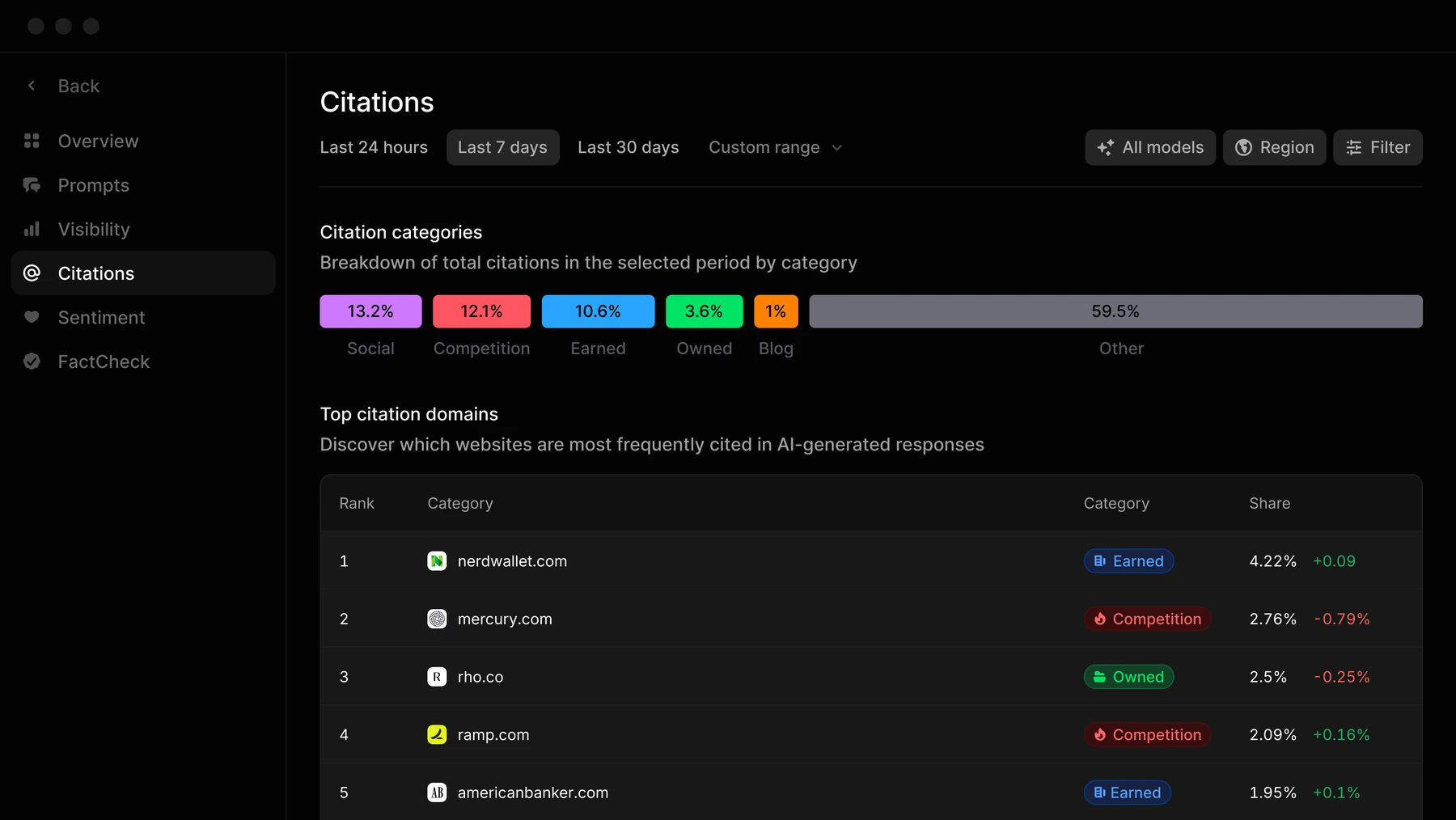
That citation view is the best screen in this whole post. It shows you which outside sites AI trusts in your category, and that is your PR and outreach list right there.
People who use it like the interface, the analytics, and the support. The usual complaint is the learning curve, especially if you are new to AI tracking. There is also no public price for brands. The free trial runs 50 prompts daily for 7 days on ChatGPT, Gemini, and AI Overviews, but Profound picks those prompts for you based on your industry, and the trial keeps no history or exports. So it shows you the tool, not how you do on the questions your buyers ask. After that it is a sales call. If you have a team that will act on this every week, it is worth it. If it is just you with an hour a month, it is a Ferrari sitting in the garage.
2. Peec AI
Peec is the one I would hand a marketing team that wants daily numbers without an enterprise contract. Starter is $95 a month for 50 prompts, Pro is $245 for 150, and Advanced is $495 for 350. Every plan comes with unlimited users.
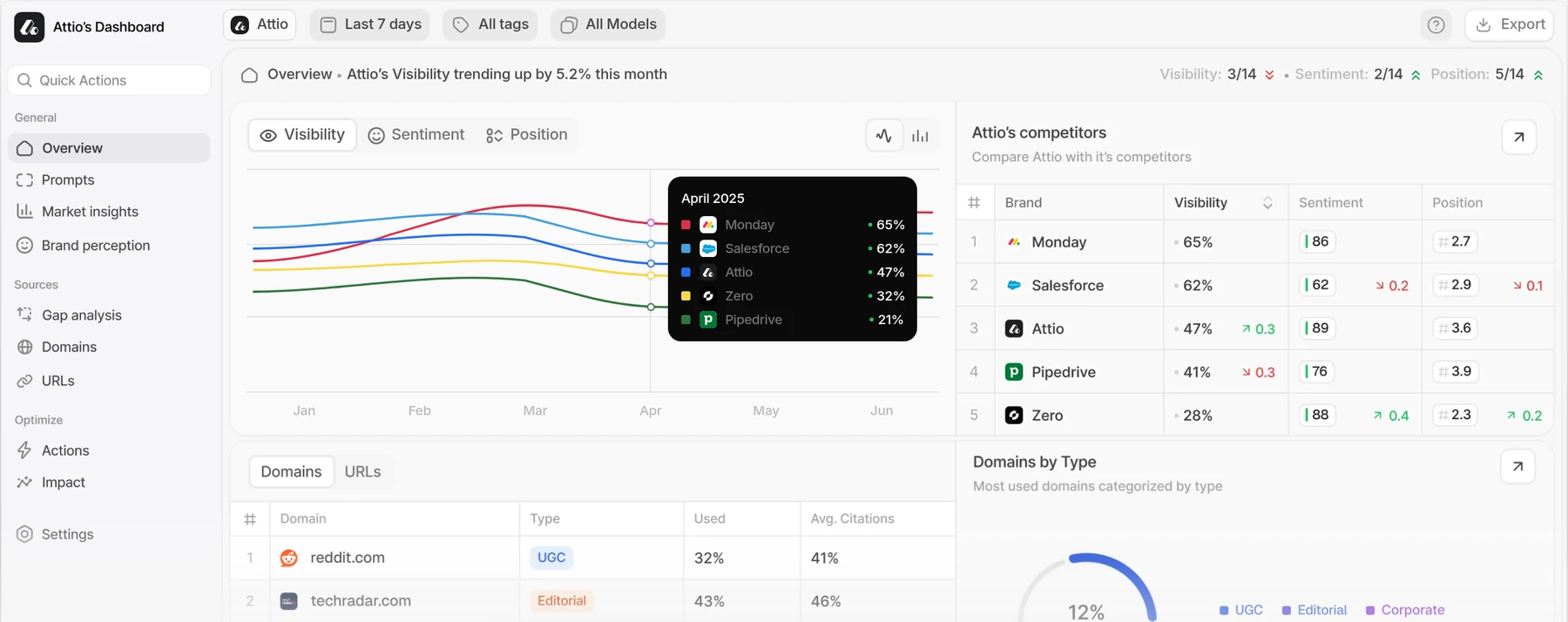
Two features make it worth the money. The gap analysis shows the sites that keep mentioning your competitors and never mention you, which turns the dashboard into a real to do list. And it checks which of 40 plus AI bots your robots.txt allows or blocks, and if you connect your CDN or WordPress, which AI bots hit which pages. Plenty of sites shut AI crawlers out without meaning to, between security plugins and Cloudflare, which started blocking AI bots by default in July 2025.
People who use it like how easy it is. On the bigger plans the data also plugs into Looker Studio, and the API is enterprise only. The complaints are about limits. You only get to pick 3 AI platforms on the regular plans, and some users say the recommendations are not specific enough to their business yet. Perplexity and anything past three cost extra, about $30 a month per platform on Starter with annual billing. For most businesses I would spend those three slots on AI Overviews, ChatGPT, and AI Mode.
3. Semrush AI Visibility
If your team already uses Semrush every day, do not buy anything else yet. Semrush rolled AI visibility into its regular SEO plans. The Starter plan is $199 a month and tracks 50 prompts daily, and Pro+ is $299 for 100. If you do not use Semrush, the AI Visibility Toolkit is sold on its own for $99 a month with 25 tracked prompts, though there is no free trial.
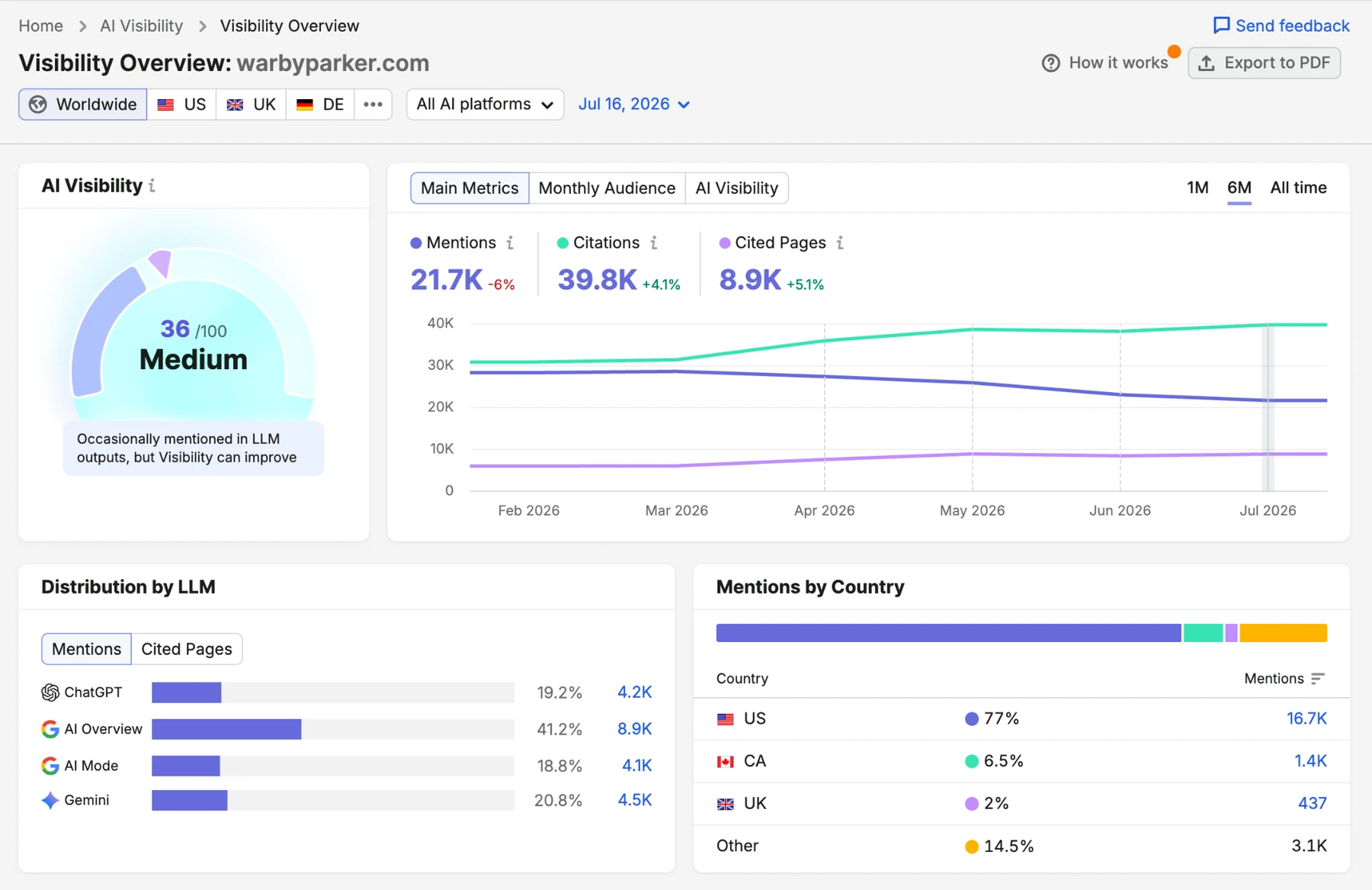
The Visibility Overview report is the part I like. It breaks your mentions and citations down by platform and country, so you can see that a brand is doing fine in AI Overviews and barely there in ChatGPT. That split tells you where to focus, because each platform leans on different sources.
Twenty five prompts runs out fast though, and fifty is not much better. It covers one product line, not a whole business, and extra prompts cost $60 a month for every 50. The biggest gripe Semrush users have has nothing to do with AI. It is the price, plus add ons that are hard to keep track of, and this is one more.
4. Ahrefs Brand Radar
I live in Ahrefs, so I am biased here, but Brand Radar is the tool I would open before paying for any tracker. You type in any brand, yours or a competitor’s, and see where it shows up across AI Overviews, AI Mode, ChatGPT, Perplexity, Gemini, and Copilot, pulled from a database of 496 million prompts. It also tracks which Google searches trigger an AI Overview or AI Mode answer and if your brand is in it, which is about as close to keyword research for AI Overviews as it gets right now.
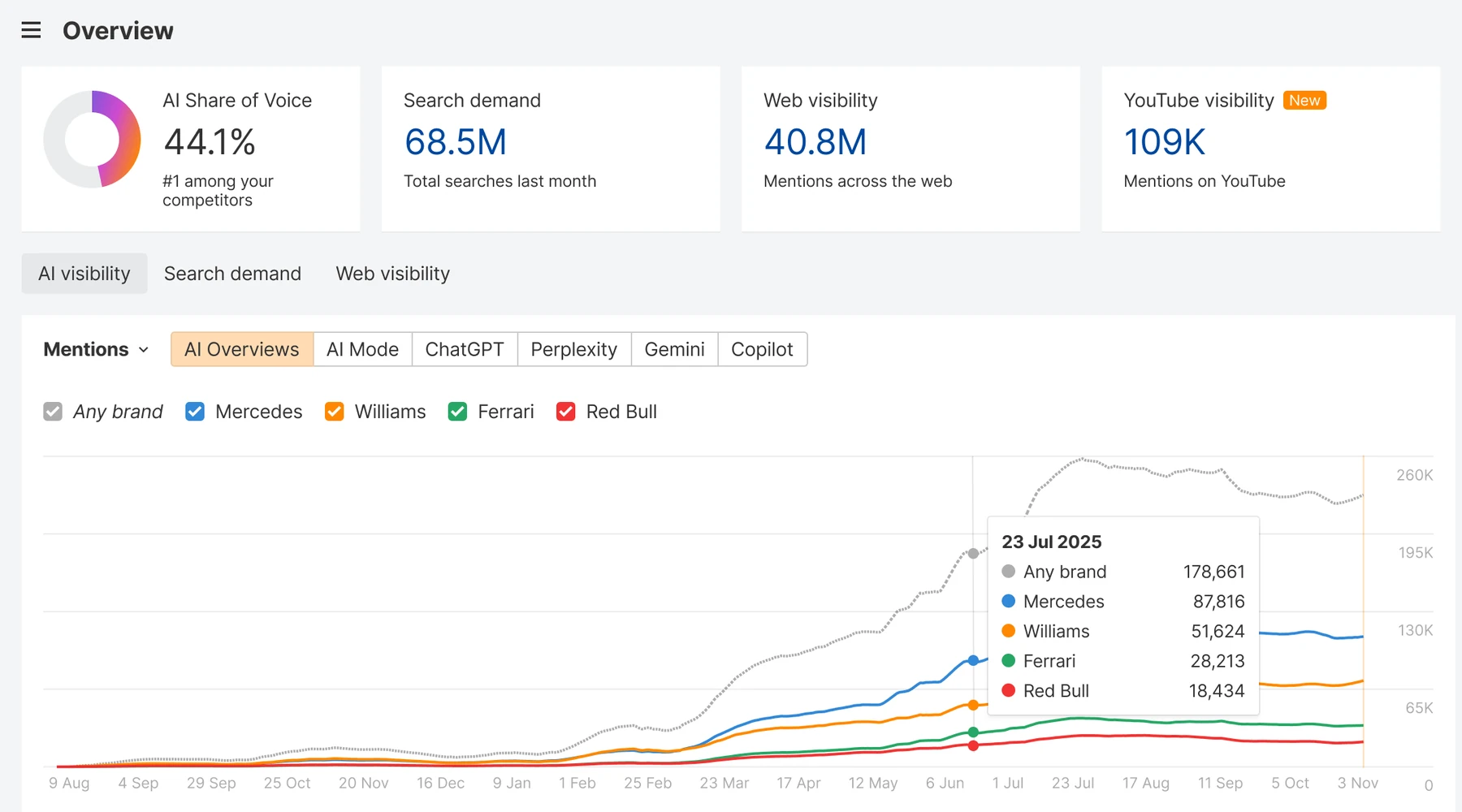
A tracker tells you how you are doing on your own prompts. Brand Radar tells you who AI already recommends in your space and where those brands get mentioned. That is worth knowing before you spend a dollar on a tracker. It also tracks mentions on YouTube, TikTok, and Reddit, and those matter more than people think. Ahrefs’ own study of 75,000 brands found AI visibility tracks brand mentions far more closely than backlinks, which I got into in our GEO vs SEO post.
If you already pay for Ahrefs, you already have some of this. Every paid plan comes with free custom prompt tracking. Lite gets 150 checks a month, which is 5 prompts checked daily on one platform, and Standard and Advanced double that each step up. Point those at AI Overviews and you are tracking your top buyer questions for nothing. The full AI Visibility Index is $199 a month on top of your plan, and extra custom prompts start at $50 a month.
My problem with the Index is coverage for small brands. It is built from Ahrefs’ keyword database, so a business that barely gets searched by name will see thin data, and Ahrefs says as much on its own pricing page.
5. AthenaHQ
AthenaHQ covers more AI platforms than anything else under $300. The free plan comes with 300 credits across 5 platforms, where one credit is one AI answer, so that is enough to run about 60 prompts once on all five. The $295 Starter plan gives you 3,600 credits a month across 11 platforms, including AI Mode, Claude, Grok, DeepSeek, Meta AI, and Mistral.
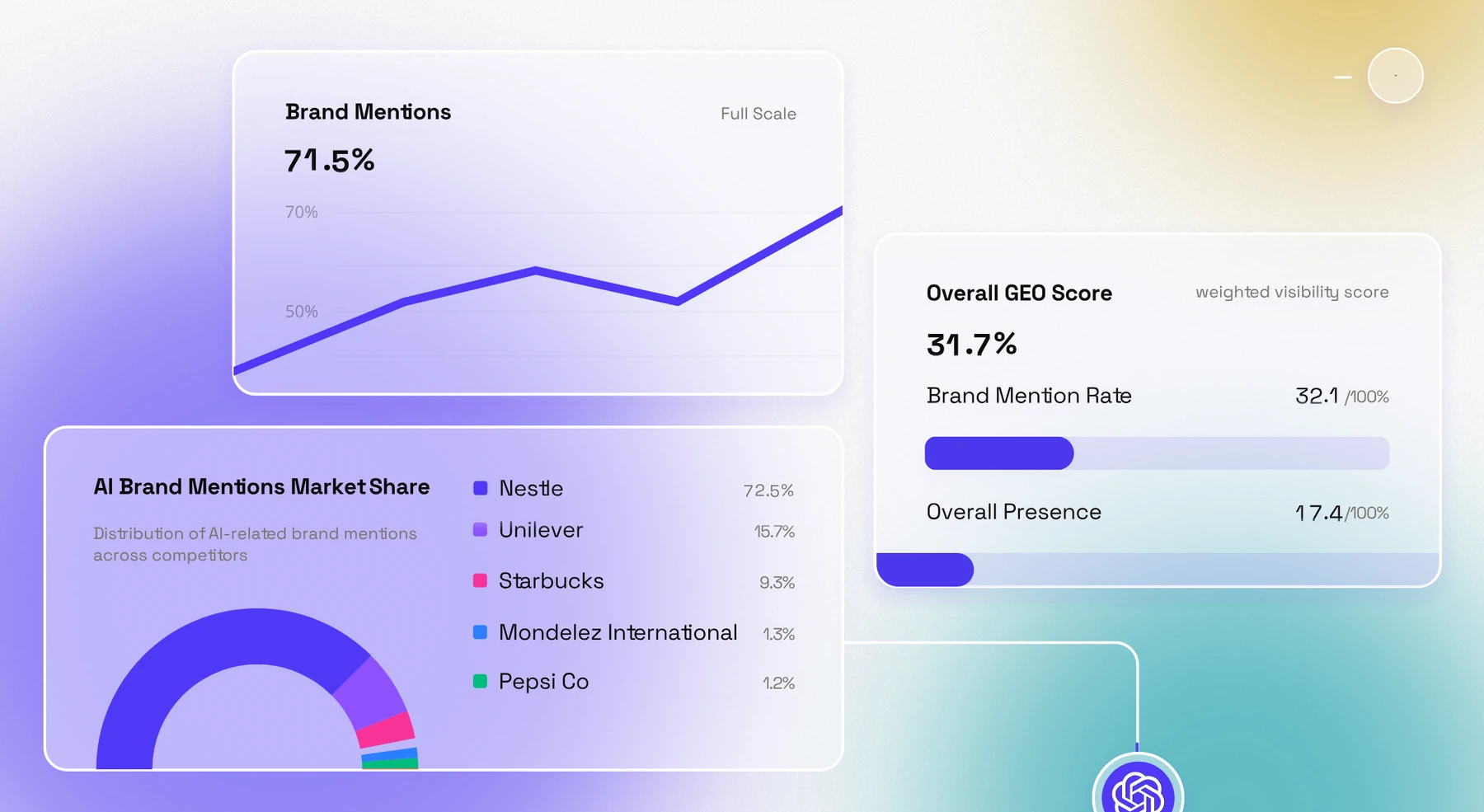
Users mostly like the insights and how accurate the data feels. A few say it is light on features for smaller clients and that prompt volume data is hard to see once you are set up.
The catch is in the credits. Starter says unlimited prompts, but run all 11 platforms every day for a month and 3,600 credits works out to about 11 prompts a day. That is fine if you check weekly or stick to fewer platforms. Do the math before you sign.
6. Scrunch
Scrunch is the one I would look at if you want tracking and site fixes in the same tool. The Core plan is $250 a month for 125 prompts, and it comes with 5 AI site audits a month, one page optimization a month, AI bot traffic tracking, and 5 user logins. It covers ChatGPT, Perplexity, AI Overviews, and Copilot. Gemini, Claude, and AI Mode are enterprise only.
Read the fine print on responses. Core caps you at 5,000 AI answers a month. Running 125 prompts on all four platforms every day would take 15,000, so you end up choosing between fewer prompts, fewer platforms, or checking less often. For tracking alone, it is a hard sell next to Peec’s Pro plan at $245 for 150 prompts checked daily.
People who use it mostly like how easy it is and how fast the support team answers. Agencies mention limited historic data and exports that make client reports harder than they should be. There is a 7 day trial, but it only tracks ChatGPT, it needs a credit card, and it rolls into a paid plan unless you cancel before day 7.
7. Otterly.AI
Otterly is the cheapest one that is real. Lite is $29 a month for 15 prompts across ChatGPT, Google AI Overviews, Perplexity, and Copilot, checked daily. Standard is $189 for 100 prompts.
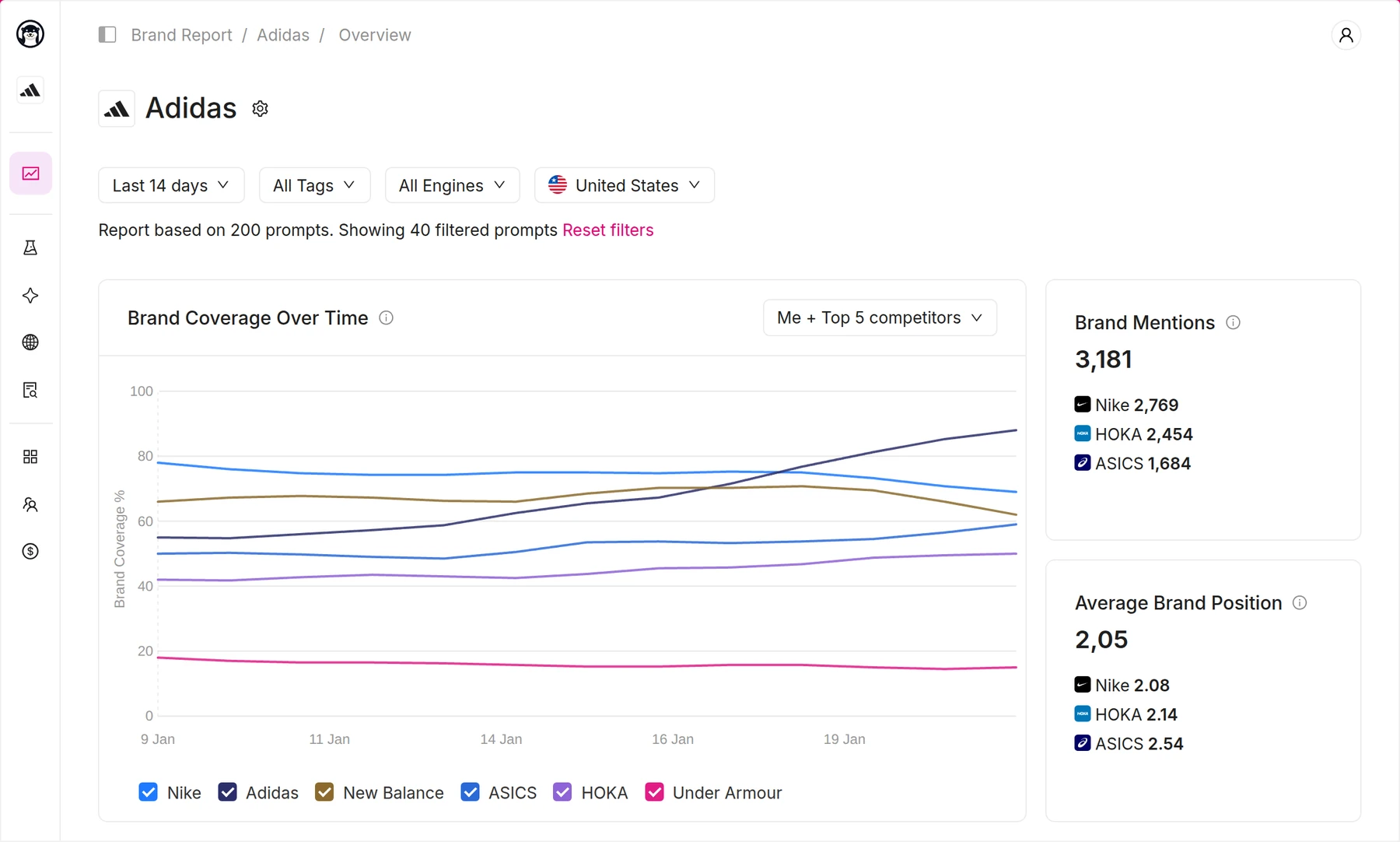
Users keep pointing to the easy setup and useful insights, though a few say the first setup takes some figuring out. For a small business that just wants to know if AI mentions them at all, $29 is a fair price to stop guessing.
Watch the add ons though. Gemini and AI Mode are $9 each on Lite and Claude is $29, so the $29 plan turns into $76 for the same 15 prompts. At that price, Peec’s Starter gets you more than three times the prompts for $19 more, on three platforms instead of seven.
How to compare prices without losing your mind
Every pricing page counts differently. Prompts, credits, checks, responses. The easy way to compare is to divide the monthly price by how many AI answers it checks in a month.
| Plan | AI answers a month | Cost per answer |
|---|---|---|
| Otterly Lite, 15 prompts on 4 platforms daily | 1,800 | 1.6 cents |
| Peec Starter, 50 prompts on 3 platforms daily | 4,500 | 2.1 cents |
| Scrunch Core | 5,000 | 5 cents |
| Ahrefs AI Visibility Index | 2,500 | 8 cents |
| AthenaHQ Starter | 3,600 | 8.2 cents |
The cheap trackers sit around 2 cents an answer. When a tool costs four times that, you are paying for something besides tracking. With Ahrefs it is the prompt database. With AthenaHQ it is the wider platform list and the content tools. With Scrunch it is the site audits. None of that is a bad deal, you just want to know what you are buying.
Track it free before you pay for anything
Spend one afternoon on the free version first. It tells you if you have a problem worth $95 a month.
- Write down 20 questions your buyers ask before they hire someone like you. Leave your brand name out. Best personal injury lawyer in Orlando tells you something. A question with your own name in it does not.
- Run each one in Google and in ChatGPT while logged out, and note who gets named and which sites get cited. Run each one twice. AI answers change from one run to the next, which is also why no tracker can give you an exact position.
- In GA4, look at referral traffic from chatgpt.com, perplexity.ai, gemini.google.com, and copilot.microsoft.com. That is the AI traffic you can measure. AI Overview clicks will not be in there, they sit inside google organic.
- If you pay for Ahrefs, turn on the free custom prompts and point them at AI Overviews.
Do that once a month for three months. If the same competitors keep showing up and you do not, buy a tracker. If nobody in your space shows up the same way twice, you have some time.
A few that almost made it
Brandlight is built for big enterprise brands, and there is no public price, only demos. If you are a Fortune 500 marketing team, put it on your shortlist next to Profound.
HubSpot AI Search Grader is free and scores how ChatGPT, Perplexity, and Gemini talk about your brand, though you fill out a form to see the full report. Good for a first look, useless for tracking.
Bing Webmaster Tools has a free AI Performance report with real citation data straight from Microsoft. It covers Copilot, Bing’s AI summaries, and a few partners Microsoft does not name, and that is not where most of your buyers ask questions.
None of these will get you into ChatGPT
This is the part the tool companies skip. Every tool here measures your AI visibility. None of them improve it.
What moves the number is the same work every time. AI bots have to be able to crawl your site. Your pages have to say specific things a model can lift and quote, with a number and a source attached. And other sites your customers already trust have to mention you. A tracker tells you if that work is landing. It does not do the work for you.
Some businesses should skip the tools for now. If you are a single location business, your Google Business Profile and reviews will do more for local AI answers than any dashboard. Several of these tools also track one country at a time on their starting plans, and AI answers for local searches change from city to city. If your site has technical problems, fix those first with a technical SEO audit, because AI cannot cite a page it cannot read. And if nobody on your team will open the dashboard every week, save the money.