
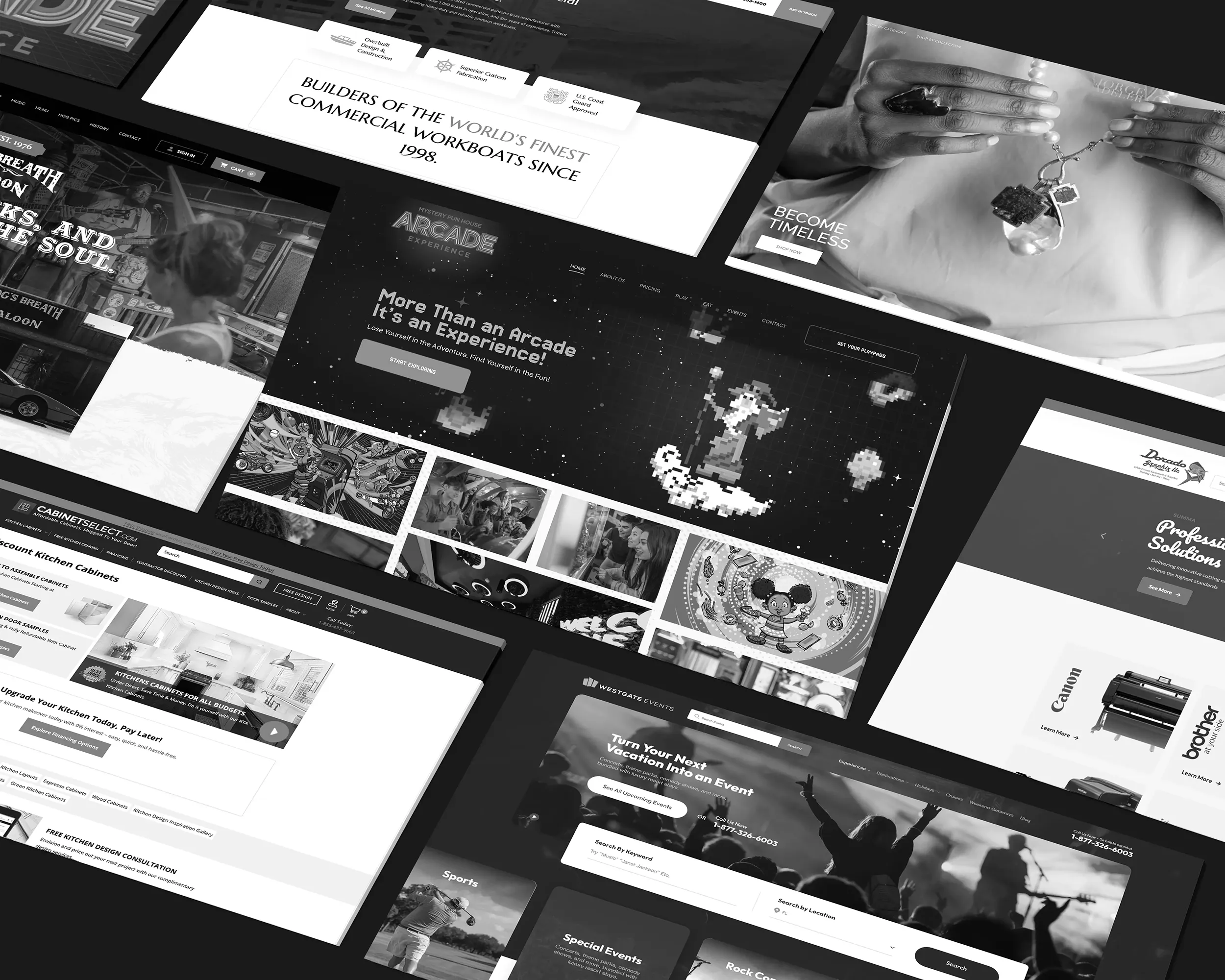
Website Design Cost at a Glance
| How you build it | Typical cost | What you get |
|---|---|---|
| DIY site builder | $200 to $600 per year | You do the work. Template layouts, limited control, platform lock-in |
| Freelancer, template based | $1,500 to $6,000 | One person, a purchased theme, light customization |
| Freelancer, custom | $5,000 to $15,000 | One person building to your requirements, timeline depends on their queue |
| US agency, custom brochure site | $8,000 to $25,000 | Strategy, custom design, custom build, SEO structure, testing |
| US agency, ecommerce or complex | $20,000 to $75,000 and up | Everything above plus catalog architecture, integrations, payment systems |
The overlap between those rows is where most confusion lives. A $6,000 quote and a $20,000 quote can both be honest, because one is a designer dropping your logo into a theme and the other is a team building something from nothing. Both are legitimate purchases. They are just not the same purchase.
The Labor Math Behind Every Quote
Here is the part most pricing pages skip, and it is the fastest way to judge whether a number makes sense.
What the People Building It Earn
The US Bureau of Labor Statistics puts the median wage for web developers and digital designers at $45.85 an hour, or $95,380 a year, as of May 2024. Web and digital interface designers specifically earn a median of $98,090.
That is take-home wage, not billing rate. Any agency employing that person also carries payroll taxes, benefits, software licenses, hosting infrastructure, project management, and the non-billable hours between projects. The standard multiplier lands somewhere between two and three times raw wage, which is how you arrive at agency rates of $100 to $150 an hour.
What That Means for Your Quote
Run a real project through it. A custom brochure site with strategy, design, development, content integration, and testing takes somewhere between 80 and 150 hours of skilled work. At $45.85 an hour, the raw wages alone come to $3,700 to $6,900 before anyone has paid rent, bought a license, or made a dollar.
So when you see a $500 custom website, you now know what you are looking at. Either it is a template with your logo dropped in, which is a legitimate product at that price, or the hours are happening somewhere with a very different cost of labor. Neither is fraud. Both are worth understanding before you compare that quote to one from a US agency.
What Different Types of Websites Cost
Brochure and Service Websites
Five to twenty pages covering who you are, what you do, and how to reach you. The workhorse of professional services, contractors, clinics, and local businesses.
Custom built by a US agency, expect $8,000 to $25,000. The spread depends on page count, how much custom design each template needs, and whether content is written for you or supplied by you. Our web design services sit in this range for most projects.
Ecommerce Stores
Everything a brochure site needs plus product architecture, category structure, cart, checkout, payment processing, shipping logic, and inventory syncing.
Expect $20,000 to $75,000 and up. A store with 50 products and a straightforward checkout is a very different build from one with variants, wholesale pricing tiers, and an ERP integration. Platform matters too, since WooCommerce and Shopify carry different development requirements. See our ecommerce website design work for what that looks like built out.
Multi-Location and Franchise Sites
A corporate site plus a location page or subsite for every market, with a management system that lets corporate control brand while franchisees update their own hours and photos.
Expect $25,000 to $100,000 and up depending on location count and how much autonomy each location gets. The build cost is only part of it, since the real engineering problem is keeping locations from competing against each other in search. That is the core of franchise and multi-location work.
Website Redesigns
Rebuilding an existing site is sometimes cheaper than starting fresh and sometimes more expensive. Cheaper when the content and structure are sound and only the design is dated. More expensive when you are untangling years of accumulated technical debt while preserving rankings you cannot afford to lose.
Expect $10,000 to $40,000 for a professional redesign. The rankings preservation work alone, redirect mapping, metadata migration, link retention, is a meaningful slice of that number. Our website redesign service covers it.
Dealership and Inventory Sites
Any site where the product catalog updates constantly and syncs with outside systems. Vehicle inventory, equipment listings, real estate.
Expect $20,000 to $60,000 and up. The website is the visible part. The inventory feed, the filtering system, and the syncing with your management software are where the hours go, which is why dealership sites price closer to ecommerce than to brochure sites.
What You Pay After Launch
The build is the big number, but it is not the only number. Ongoing costs are small individually and easy to forget when budgeting.
| Ongoing cost | Typical annual cost | Notes |
|---|---|---|
| Domain registration | $10 to $50 | Renews yearly. Some premium extensions cost more |
| Hosting | $200 to $3,000 | Shared hosting is cheap and slow. Business sites want managed hosting |
| SSL certificate | $0 to $200 | Free through Let’s Encrypt and most quality hosts |
| Maintenance and updates | $1,200 to $12,000 | Security patches, plugin updates, backups, uptime monitoring |
| Ecommerce platform fees | $350 to $4,000 | Shopify and similar platforms charge monthly, plus transaction fees |
| Content and SEO | Varies widely | See our SEO pricing page for what ongoing search work costs |
Maintenance is the line item people skip and then regret. An unmaintained WordPress site accumulates security vulnerabilities and plugin conflicts until something breaks, usually at the worst time. Budget for it up front rather than paying emergency rates later.
The Seven Things That Move the Price
Page Count and Template Count
Twenty pages built from four templates costs far less than twenty pages each needing its own design. Ask any quote which number they are working from.
Custom Design Versus a Theme
A purchased theme customized to your brand is a legitimate, cheaper path. A design built from your brand up costs more because someone is actually designing rather than adjusting.
Who Writes the Content
Content is regularly the thing that stalls a project for two months. If the agency writes it, the price goes up and the timeline gets predictable. If you write it, you save money and become the bottleneck.
Integrations
Every outside system your site talks to, CRM, booking software, inventory management, payment processors, email platform, adds development hours and testing.
Ecommerce Complexity
Product variants, tiered pricing, subscriptions, and multi-currency each multiply the work. Fifty simple products is a straightforward build. Fifty products with six variants each and wholesale pricing is not.
Photography and Assets
Stock imagery is cheap and looks it. Custom photography costs real money and is often what separates a site that looks credible from one that looks templated.
Timeline
Compressing a twelve-week build into six means overtime, more people, or both. Rush work carries a premium for the same reason it does in every other trade.
Template Versus Custom
A template site is not a scam. For a business that needs a presence and nothing more, a good theme on solid hosting is a reasonable purchase and we will tell you so.
What Templates Cost You in Speed
Templates carry code written for every possible use case, which means your site loads code it will never use. That weight shows up in your page speed, and page speed is a ranking factor Google is public about. Page builders compound the problem by generating heavy markup for layouts that clean code handles in a fraction of the size.
What Templates Cost You in Flexibility
You inherit someone else’s structure. When your business needs something the theme did not anticipate, you are either paying a developer to fight the theme or changing your business to fit it.
We code every site from scratch for that reason. It costs more up front. It also means your site does what your business needs and stays fast years after launch, while template sites accumulate plugins until they crawl.
How We Price It
We quote on scope, not on packages that pretend every business needs the same thing.
Before we put a number on anything, we look at what you have, what you need it to do, and what your competitors are doing. Then we scope the work, price it, and put the deliverables in writing so nobody is guessing what is included.
Fixed Project Pricing
You get a number before we start, not an hourly meter that runs while you wait for an invoice you cannot predict.
Search Built In, Not Bolted On
Site architecture, page speed, schema, and internal linking are handled during the build. That is the difference between launching ready to compete and launching ready for an SEO rescue six months later.
The Same People Throughout
You talk to whoever is doing the work, start to finish.
Most of our website projects land between $[X] and $[Y] depending on scope. For a real number on your project, get a free consultation. We will look at what you have and tell you straight what it would take.
Questions We Get Asked Constantly
A custom brochure site from a US agency typically runs $8,000 to $25,000. A template based build from a freelancer runs $1,500 to $6,000. Which one is right depends on whether your website needs to compete for customers or simply exist.
Because the projects are rarely the same. One quote includes strategy, custom design, content, and SEO structure. Another includes a theme and your logo. Compare deliverables line by line and ask each provider how many hours the build represents and who performs them.
Sometimes. If you need a presence and nothing more, a good template on decent hosting does the job. If your website is meant to bring in customers, the cheap version usually costs more within two years, because you end up rebuilding it properly anyway.
Most custom brochure sites take 6 to 12 weeks. Ecommerce and multi-location builds run 12 to 24 weeks. The single biggest cause of delay is content, so if you are supplying copy and images, start early.
Domain, hosting, SSL, and maintenance at minimum. Realistically $1,500 to $15,000 a year depending on site complexity and whether you are also investing in content and search.
You should. Ask directly, and get the answer in writing. Some agencies retain ownership of the code or lock you into proprietary platforms you cannot leave without rebuilding from scratch.
WordPress suits content-heavy and service businesses. Shopify suits stores that want the platform to handle payments and infrastructure. WooCommerce suits stores that want WordPress flexibility with ecommerce attached. The right answer depends on your catalog, your team, and what you need to control.
Ready for a Real Number?
Ranges help you plan. They do not help you decide. Tell us what you are building and we will scope it properly, then give you a fixed price and a timeline you can hold us to.
Get a Free Consultation Or see what we have built for businesses like yours.
Sources
- US Bureau of Labor Statistics, Web Developers and Digital Designers, median wage data as of May 2024
- Google Search Central, Core Web Vitals and page experience
- Let’s Encrypt, free SSL certificate authority