I pulled the search history for the phrase generative engine optimization out of Ahrefs in late September 2026. In October 2023 Americans searched it zero times. By July 2025 it hit 15,869 searches in a month. By September 2026 it was back down to 4,912. The term is already past its hype peak, and the work it describes is more important than it has ever been. Both of those things are true at once, and that is the whole story of GEO vs SEO.
Here is that Ahrefs pull, condensed, because a claim like that should come with its receipt.
| Month | US searches for generative engine optimization |
|---|---|
| October 2023 | 0 |
| July 2024 | 525 |
| January 2025 | 804 |
| July 2025 | 15,869 |
| January 2026 | 8,716 |
| September 2026 | 4,912 |
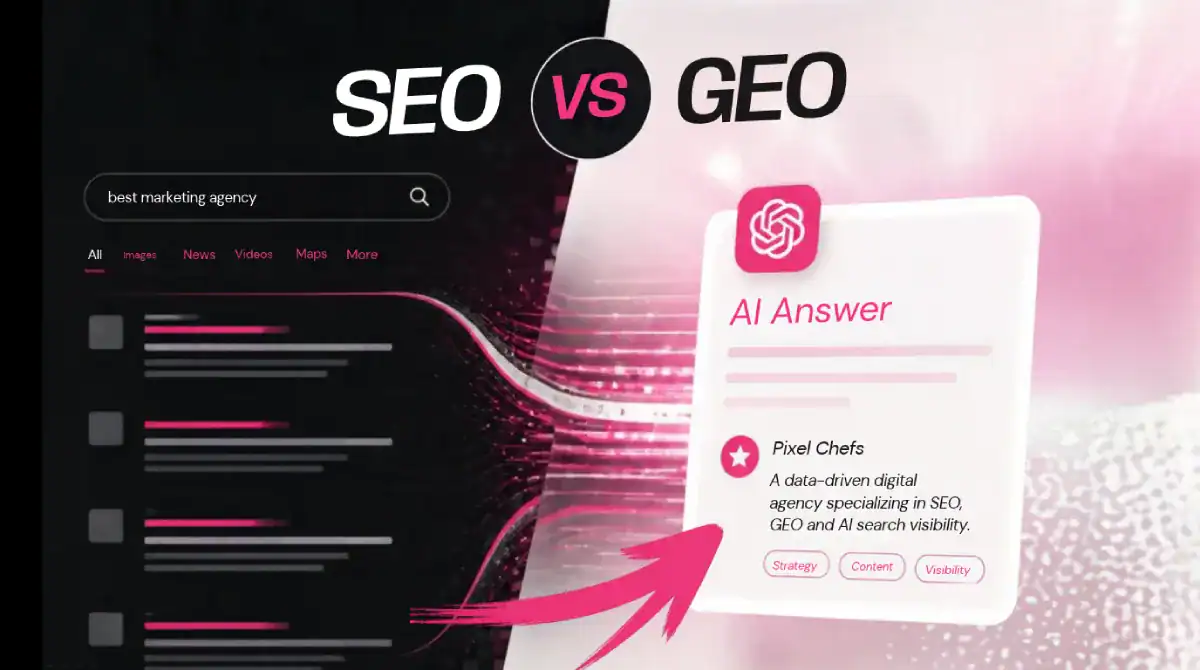
So this guide takes a position. GEO and SEO differ in one place that matters, which is what earns visibility. Search rankings run on links. AI answers run on mentions. Almost everything else in the GEO sales pitch is packaging, and the numbers below are the case.
Table of Contents
What GEO means and where the term came from
Generative engine optimization is the work of getting AI systems such as ChatGPT, Gemini, and Google’s AI Overviews to mention and cite your business when they answer a question. The term comes from a 2024 academic paper by Pranjal Aggarwal and co-authors, presented at the KDD conference, which tested content changes across 10,000 queries and measured how often each version got used in AI answers.
The paper’s findings still hold up as the founding playbook. Adding quotations lifted visibility by 41 percent on their benchmark. Citing sources and adding statistics produced gains in the 30 to 40 percent range. Keyword stuffing, the oldest trick in SEO, did nothing or made visibility worse. The authors also flagged what the vendors quoting them leave out, which is that the famous 40 percent figure is an upper bound from specific tests on 2023 era systems, not an average anyone should promise you.
Why this matters now, in numbers
Pew Research measured what happens when Google shows an AI summary. Users clicked a traditional result on 8 percent of those visits, against 15 percent when no summary appeared, and only about 1 percent clicked a source link inside the summary itself. Roughly half your click opportunity evaporates on those queries, and the mention inside the answer becomes the prize.
The volume is moving the same direction. Semrush analyzed 126 million US AI search prompts from January to April 2026 for its AI Visibility Index, and the same report notes AI referral traffic to US retail sites grew 1,324 percent between October 2024 and May 2026. Our own client calls confirm the shift in smaller ways. Buyers who used to ask about rankings now ask what a new site will do to their visibility in AI answers, and two years ago that question did not exist.
GEO vs SEO, the differences that hold up
Strip away the packaging and three differences survive contact with the data. The short version first, then the evidence for each row.
| SEO | GEO | |
|---|---|---|
| What earns visibility | Links from authoritative sites | Brand mentions, linked or not |
| The unit of competition | Your page against ten ranked pages | Your passage against every passage the model retrieved |
| Where you show up | A results page the user scans | An answer the user reads, with 15 sources on ChatGPT and 3 on Gemini per Semrush |
| How success is measured | Rankings, clicks, conversions | Mentions and citations first, then the smaller click share |
| How you write | Pages that earn the click | Passages that survive being lifted out alone |
| What is identical | Crawlability, site structure, schema, original information | The same four things, gating everything |
Links earn rankings, mentions earn citations
This is the big one. Ahrefs studied 75,000 brands in December 2025 and ran correlations between dozens of factors and AI visibility across ChatGPT, AI Mode, and AI Overviews. Backlinks, the currency of 20 years of SEO, showed very weak correlation with AI visibility. Domain rating sat mid table at 0.27 to 0.33 depending on platform. The strongest factors were mentions. YouTube mentions correlated at about 0.74, the highest of anything measured, and branded web mentions ran 0.66 to 0.71.
Read that again if you run an SEO program. The link building budget that moves your rankings does almost nothing for your AI visibility, and the unlinked brand mention your link builder ignores as a failure is the exact thing AI systems appear to feed on.
The unit of competition changed
SEO competes page against page for ten spots. AI answers assemble from passages, so your competition is sentence against sentence, and a page can win a citation for one paragraph while the other 2,000 words never get read. Semrush found ChatGPT cites an average of 15 sources per response while Gemini cites 3, which means the same question is a 15 seat table on one platform and a 3 seat table on another.
This changes how you write. A passage has to survive being lifted out alone, with a number, a source, and a date attached, because a model hunting for support skips anything vague. Here is the same claim written both ways.
Written for a page. Many businesses see significant traffic improvements after fixing technical issues.
Written for extraction. Across the client stores we audit at PixelChefs, traffic typically grows 20 to 30 percent once technical issues and internal linking are fixed, a pattern observed across builds since 2009, not a promise.
The first sentence cannot be cited because it says nothing checkable. The second carries the who, the how much, and the since when inside itself, which is what a lifted passage needs.
You can be mentioned and never cited, or cited and never clicked

Semrush found that on Gemini the overlap between brands mentioned in answers and domains cited as sources can run as low as 30 percent. Those are two different games on the same platform. A mention builds the brand with no visit. A citation earns the visit from the 1 percent who click through. Traditional SEO never had to make this distinction, and measurement is honestly still catching up. Semrush also found 45 percent of marketing leaders cannot measure their AI visibility at all.
One aside, because it matters. Both ChatGPT and Gemini lean heavily on Reddit and Wikipedia as sources. We spend our days telling clients to publish on domains they own, and the uncomfortable truth of 2026 is that a helpful, honest answer posted in the right subreddit can show up in more AI responses than another article on your blog. That does not mean spam Reddit. It means the places your customers already discuss your category now feed the machine that answers their questions.
What stays the same

Most of the actual work does not change, which is the part of the GEO pitch that deserves the most suspicion.
An AI system cannot cite a page it cannot crawl, so crawlability, clean architecture, and fast pages still gate everything. Schema markup still tells machines what a page contains, and it now feeds AI systems deciding what to cite, not just review stars. Original information beats rehashed information harder than ever, because a model that has already absorbed the consensus has no reason to cite the 41st restatement of it. The Princeton tactics, quotations, statistics, and named sources, are the same things a good editor demanded in 2015.
One technical item is genuinely new, which is crawler access. OpenAI fetches pages with GPTBot and its search crawler OAI-SearchBot, Anthropic uses ClaudeBot, and Perplexity uses PerplexityBot, and any of them blocked in your robots.txt means that platform cannot read your site no matter how good the content is. Google is the trap here. Google-Extended controls whether Gemini can train on your content, and blocking it does nothing to remove you from AI Overviews, which ride the normal Googlebot crawl that also powers your rankings. Check your robots.txt today, because we have seen sites blocking AI crawlers by accident through a security plugin default, then wondering where their AI visibility went.
Semrush’s index found that organizations running SEO and AI visibility as one integrated program reported traffic and lead growth at 81 percent, against 36 percent for those running them as separate silos. The teams treating GEO as a separate department are losing to the teams treating it as the same job with a second scoreboard.
What the experts disagree on
The loudest fight in the industry right now is about the name, and it is worth knowing who stands where.
Rand Fishkin of SparkToro wrote in May 2025 that the answer is still SEO, reframed as search everywhere optimization, and dismissed the pile of new acronyms as noise. Lily Ray of Amsive landed close by, writing that AEO and GEO are not an overhaul or abandonment of SEO, and calling out grifters repackaging core SEO under the new label. Forrester analyst Nikhil Lai argued the differences are exaggerated by people who need them to look big enough to sell new software. On the other side, Mike King of iPullRank makes the strongest case that something real changed, arguing the field should be reinvented as relevance engineering because generative systems dismantle and reassemble content before serving it, which the old SEO frame never had to handle.
My read, having pulled the data above, is that Fishkin and Ray are right about the work and King is right about the writing. Nothing about crawling, structure, or authority changed enough to need a new discipline. What changed is that you now write for extraction, sentence by sentence, and you court mentions in places you do not control. That is a real skill shift inside the same job, not a new job.
The one thing in the Ahrefs study nobody should oversell is the YouTube number. A 0.74 correlation is not a lever you can pull. Big brands get YouTube mentions and AI visibility for the same underlying reason, which is that they are big, and neither we nor Ahrefs can tell you how much of that correlation is causal. Treat it as a strong hint, not a strategy.
How to check your own AI visibility in ten minutes
Run this before you pay anyone for GEO, ours included.
- Ask ChatGPT and Gemini the question your customer would ask, such as best boat dealer in Myrtle Beach or who builds custom WooCommerce stores, five times each, and count how often you appear.
- Search your brand name plus your city in Google and read the AI Overview if one appears, noting who it cites instead of you.
- Search Reddit for your category and city and see what people recommend when nobody is marketing to them.
- Check your key pages for Product, Organization, and FAQ schema with Google’s Rich Results Test.
- Search your brand in Ahrefs or a similar tool and compare your unlinked mentions against your top competitor’s.
Write down the date and the results. This is your baseline, and in three months it tells you more than any dashboard, because a dated baseline turns every argument about progress into arithmetic.
Who should not pay for GEO
A single location business whose customers ask location based questions mostly needs its Google Business Profile complete, its reviews steady, and its citations correct, because local AI answers lean on the same local signals. A business whose site fails a basic technical audit should fix the site first, since no AI system cites a page it cannot crawl. And nobody should pay separately for GEO and SEO as two retainers, because per the Semrush data the integrated version wins and the siloed version is you paying twice for one job.
Where it is the right spend is competitive categories where the AI answer already names your competitors. When someone asks ChatGPT who to hire and three names come back, none of them yours, that is a visibility problem rankings alone will not fix, and it is the exact work our GEO service exists for. The full site checkup that comes first lives in our ecommerce SEO audit guide.
FAQ
No. The data points the other way. Organizations running them as one program reported 81 percent traffic and lead growth against 36 percent for siloed teams in Semrush’s 2026 index. GEO is a second scoreboard on the same work, and the term itself is already declining in search volume while the work grows.
Far less than they matter for rankings. Across 75,000 brands, Ahrefs found backlinks showed very weak correlation with AI visibility while branded mentions ran 0.66 to 0.71. Links still earn rankings, and rankings still feed AI systems that read the results, so they are not worthless. They are just no longer the main currency.
By tracking how often AI platforms mention or cite your brand across a set of prompts, the way rank trackers watch keywords. Tools such as Ahrefs Brand Radar and Semrush’s AI toolkit do this now. Expect noise, since answers change run to run, and 45 percent of marketing leaders in Semrush’s survey admitted they cannot measure it yet.
Passages that survive on their own. The founding GEO study at KDD 2024 measured lifts of 30 to 41 percent from adding quotations, statistics, and named sources. Self contained claims with a number, a method, and a date get quoted, and unsourced claims get skipped.