In 2011 you could rank a website with links from article directories no human being ever read. Everyone in this industry knew it, most of us used it, and in April 2012 Google shipped the Penguin update and entire businesses fell out of search inside a week. I watched that happen to sites around me, and every opinion I hold about link building was formed by watching it.
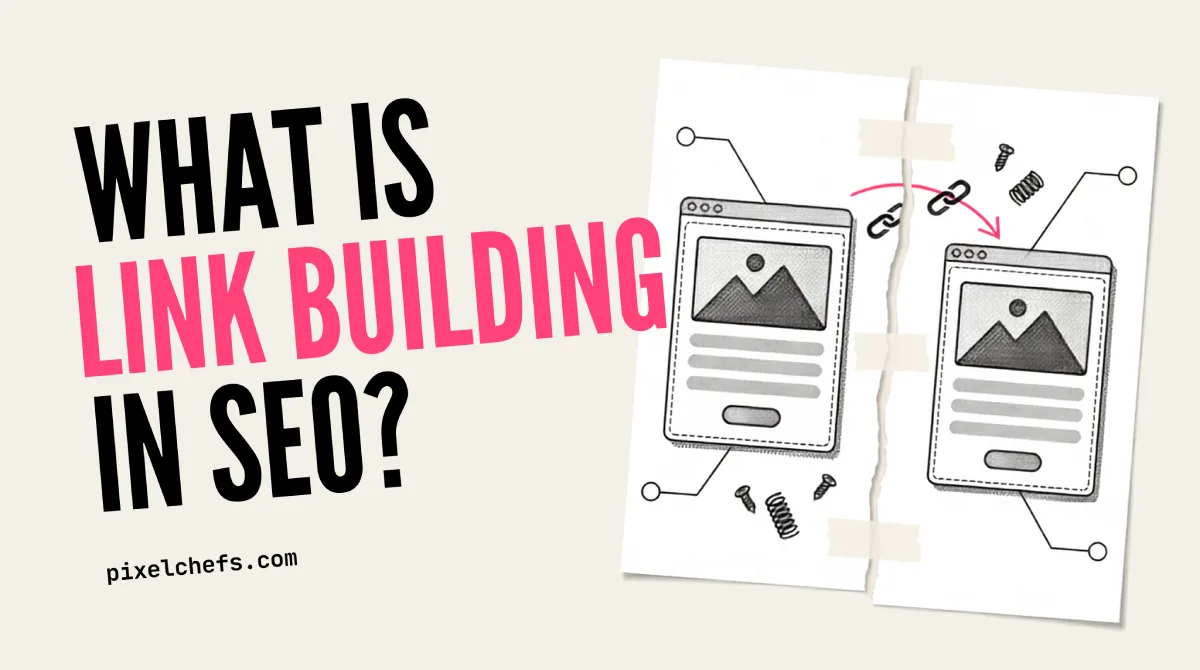
So here is the definition, and then the part that matters. Link building is the practice of getting other websites to link to yours. Search engines read each link as one site vouching for another, and pages with references from trusted places outrank pages without them. Ahrefs crawled roughly a billion pages in 2020 and found that 66.31 percent of them had no backlinks at all, which goes a long way toward explaining why most pages never see search traffic. Links are real, they move rankings, and most of what gets sold under the name link building is junk. This guide is about telling the two apart.
Table of Contents
Why links still move rankings in 2026
Google has changed almost everything about how it ranks pages since 2009. It has never stopped using links, because a reference from a trusted site is still the hardest signal to fake at scale. A good link also does a second job that gets forgotten, which is sending actual readers. A mention on a site your customers already trust brings visitors who arrive half convinced.
There is a newer third job. AI search tools decide which businesses to cite partly by reading which sites reference them, so the same links that earn rankings now earn citations in AI answers. The work has not changed. The payout got bigger.
The link building eras that came and went
You can learn most of what matters about link building from what stopped working, so here is the short history, from someone who was billing clients through all of it.
Directories and article farms came first. Thousands of links from pages nobody read, and it worked until Penguin made those exact links a liability. The sites that survived were the ones whose links a human would have wanted anyway. Then came the guest posting boom, where every inbox in America filled with offers to write for sites that existed only to hold guest posts. Google caught the pattern, and generic guest posting went from a tactic to a tell.
Private blog networks are the era that still will not die, because the pitch sounds like math. I sat across from a business owner who had paid a link network five thousand dollars a month. He got five links a month for it, and when we pulled his rankings, nothing those links touched had moved. Another owner had paid a PR firm for 17 press releases and could not point to one ranking, one lead, or one link with real traffic behind it. A third had run HARO in house for months without landing a single placement.
Digital PR is the era we are in now, and it is the real thing with a real flaw. When an original study or data piece lands, it earns links nothing else can reach. Most of them do not land, and the hours are spent either way. We recommend it to businesses that can afford ten attempts, not to businesses betting the budget on one.
Link building methods that still earn links
Publish something worth citing
The most durable link building is making the thing people reference. Original data from your own business, a genuinely complete guide, a free tool or calculator. These earn editorial links, meaning a writer chose to cite you with nobody asking, and editorial links are the exact kind search engines weight hardest because they are the hardest to manufacture.
The best link building we have ever done was an accident. Every site we build carries a small PixelChefs credit in the footer. A business owner audited a competitor that kept outranking him, dug through the site to find out why, found our name at the bottom, and called us. The work itself was the outreach. That is the standard your linkable content has to hit, and it is a high one, which is exactly why it keeps working.
Outreach that a human would answer
Here is the outreach email that lands in our inbox, in some version, every single week.
Dear webmaster, I came across your wonderful blog and I must say it is very informative. I have written a high quality article that your readers will love. Kindly add my link to your resources page and I will share your site with my audience.
Nobody has ever answered that email, and a version of it is being sent on your behalf right now if you hired the wrong agency. Real outreach is narrow. Find the specific page discussing the thing you have data on, name the sentence your resource improves, and say it in four lines a busy editor can act on. One placed link from ten careful emails beats zero from a thousand blasted ones.
While we are on the subject of links, the links nobody audits are the ones on your own site. We have crawled stores where the money page had two internal links pointing at it while the returns policy had two hundred. Internal links are free, you control every one of them, and moving them is often worth more than a month of outreach. Different topic, and it did not deserve to be left out of a post about links.
Resource pages and broken links
These two classics are unglamorous and both still work. Find curated resource lists in your niche and give the maintainer a specific reason your page belongs. Or run a crawler such as Screaming Frog across relevant sites, find dead outbound links, and offer your working page as the replacement. The maintainer fixes an error, you earn a link, and nobody had to pretend the email was personal.
Guest posting, with one test
Guest posting still works on genuinely relevant sites where your byline belongs. The test has one line. If you would not be proud of the piece without the backlink in it, do not write it.
Good links vs bad links
| A link worth having | A link that hurts or does nothing |
|---|---|
| Comes from a site in or near your industry. | Comes from a site with no connection to what you do. |
| Sits inside content, placed by an editor’s choice. | Sits in a footer, sidebar, or link dump. |
| Comes from a page with real readers and real traffic. | Comes from a page built to hold links. |
| Uses natural, varied anchor text. | Repeats your exact money keyword as the anchor. |
| Adds to a diverse set of unique domains. | Piles up from the same few domains again and again. |
| Was earned, or asked for honestly. | Was bought without disclosure or traded in a scheme. |
Google has spent two decades and several named algorithm updates learning to sort the left column from the right. Penguin was only the first.
Disavowing bad links, and when to leave them alone
I have gone back and forth on disavow files for years, and I am still not fully settled. Google says it ignores most spam links automatically, and my experience mostly backs that up. Sites collect garbage links all the time and rank fine.
We build a disavow file in two situations only. A manual action notice in Search Console, or a profile where manipulative links are the clear majority of everything pointing at the site. Outside those, the honest answer is that doing nothing is usually right, and I am aware that is unsatisfying advice from someone you might want to hire. If you are staring at a backlink report full of strange domains and feeling alarmed, the report’s job was to alarm you. Read the traffic instead.
Who should not pay for link building
We rarely sell link building on its own, and when a business asks us for it, the first thing we check is the site, because a thin site with good links is still a thin site. Some readers should close this tab and spend the money elsewhere, and I would rather name them than take the call.
A single location local business does not need a link campaign. It needs a complete Google Business Profile, steady reviews, correct citations, and a handful of local links from suppliers, sponsorships, and the local paper, most of which cost effort rather than money. A store whose product pages still carry pasted manufacturer descriptions should fix that first, and my ecommerce SEO audit guide covers the whole checkup. Link building is the right spend when the site is already good and the market is genuinely competitive. Before that point it is expensive decoration.
Link Building FAQ
No. Buying undisclosed links violates Google’s guidelines and risks a penalty that costs far more than the links were worth. Everything in the methods section above works without buying anything.
There is no number, and anyone who gives you one is guessing. A page can rank with a handful of links from trusted, relevant sites while a competitor with hundreds of junk links sits on page four. Compare the actual pages ranking for your target phrase, not a count.
Individual links can show movement in weeks, and a sustained effort typically needs three to six months before the results are worth reporting. This is a long game, which is one more reason to be sure the site deserves the links first.
There’s no magic number. The quality, relevance, and authority of links matter far more than quantity. A single link from an authoritative source in your industry can outweigh dozens from irrelevant sites. Focus on building a natural, diverse link profile rather than hitting a specific number.
Link building is a long-term strategy. While some impacts might be seen within weeks, significant results typically take 3-6 months to materialize. Google carefully evaluates new links before fully incorporating them into ranking calculations, especially for competitive keywords.
Not directly, since nearly all of them carry a nofollow tag. They still put your content in front of the writers and site owners who create real links, so they feed the process without being the process.