Shopify is easier. Every comparison you have read says it, and it is true. It is also the most expensive sentence in ecommerce, because easier is a thing you rent, and the bill for renting it never stops. That is the trade this whole decision comes down to, and almost nobody prices it out loud.
Here is where we stand, so you can weight what follows. PixelChefs is a Shopify Partner, we build WooCommerce stores on hand coded WordPress, and we run our own ecommerce business, CabinetSelect, which ranks top 10 in the country for kitchen cabinets against Home Depot and Lowe’s. We get paid either way you choose, which is exactly why we can afford to tell you the deciding question is not features. It is who maintains the thing after launch. Answer that honestly and the platform picks itself.
What each platform is, in plain terms
Shopify is a hosted platform. You pay monthly, Shopify runs the servers, the security, and the checkout, and your store lives on infrastructure you will never touch. WooCommerce is a free plugin that turns a WordPress site into a store, which means you own the site, pick the hosting, and carry the keys and the responsibilities that come with them.
Both run a meaningful share of the internet. Per W3Techs data from September 26, 2026, WooCommerce powers 8.0 percent of all websites and Shopify powers 5.4 percent. WooCommerce has more stores, Shopify has more of the polished brand names, and neither number should pick your platform, because the store next door’s choice tells you nothing about your margins.
The money, in arithmetic
Comparison posts list features. Buyers decide on math, so here is the math, using Shopify’s published 2026 pricing.
| Cost | Shopify | WooCommerce |
| Platform | $39 a month on Basic, $105 on Grow, $399 on Advanced, $2,300 and up on Plus, which is also the plan you need for any changes to the checkout process | Free plugin |
| Hosting | Included | $100 to $300 a month for hosting that can carry a store |
| Card processing | 2.9 percent plus 30 cents on Basic with Shopify Payments | 2.9 percent plus 30 cents with Stripe, and lower rates are available as your volume grows or when you negotiate with your processor |
| Extra fee on outside payment providers | 2 percent on Basic, 1 percent on Grow, 0.6 percent on Advanced | None, ever |
| Apps and plugins | $200 to $500 a month is normal for a serious store, forever | Plenty of paid plugins and options, but you can run a store without a single paid plugin |
| Maintenance | Shopify’s problem | Your problem, or your developer’s |
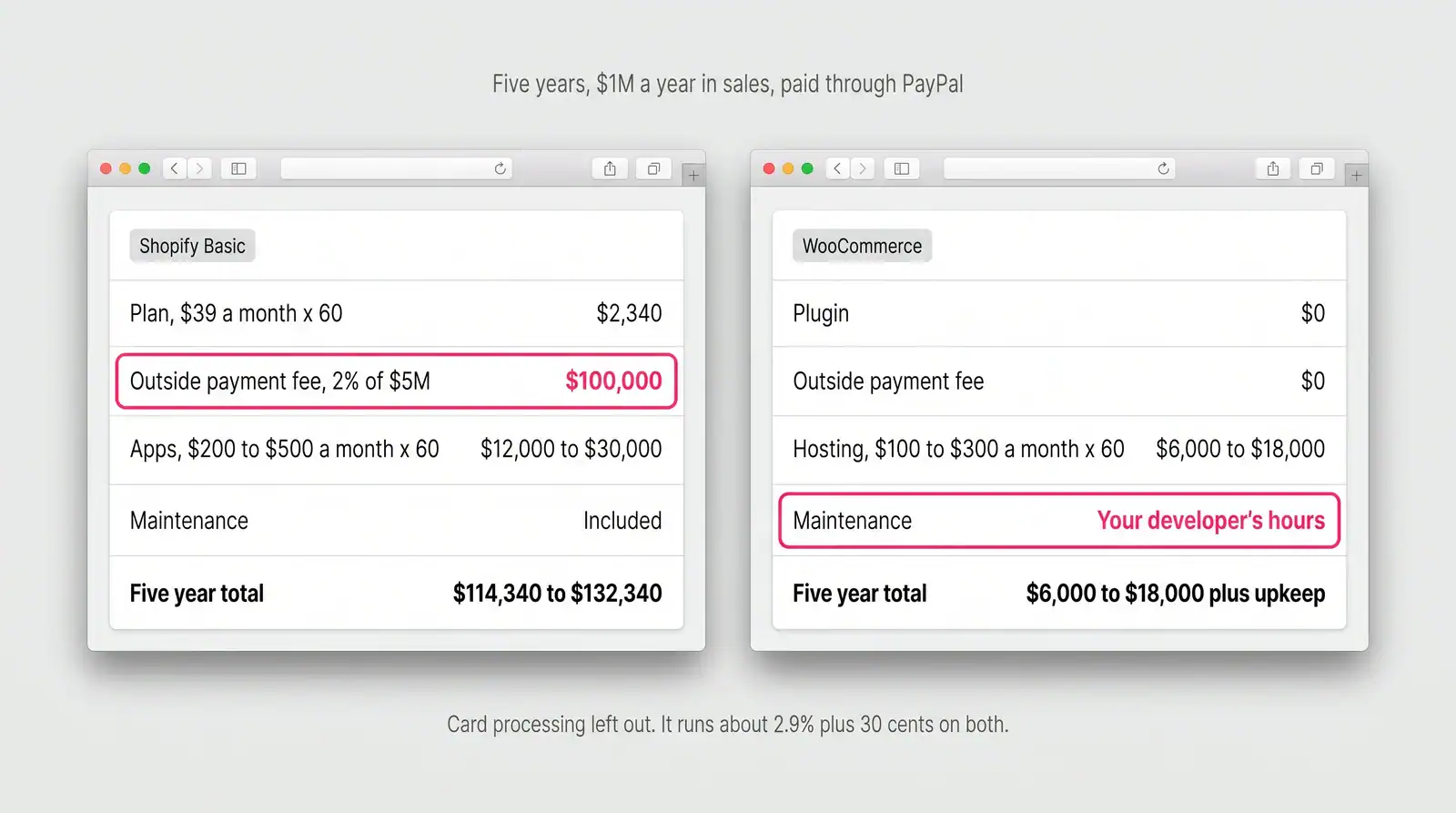
Two lines in that table do the deciding. The first is the outside payment fee. A store doing one million dollars a year on Shopify Basic through PayPal or another non Shopify gateway hands over 2 percent of revenue, which is $20,000 a year, for the privilege of not using Shopify Payments. That single line has paid for entire WooCommerce rebuilds. If your business needs a specific payment provider, a financing partner, or a high risk gateway, Shopify’s pricing is built to punish you for it, and WooCommerce does not care.
The second is maintenance, and this one runs the other way. WooCommerce is free the way a puppy is free. The plugin costs nothing, and then hosting, updates, security, backups, and the occasional plugin conflict cost money or attention every month of the store’s life. Budget $100 to $300 a month for hosting and something real for upkeep, either your own time or a developer’s hours. A WooCommerce store with nobody maintaining it is not cheaper than Shopify. It is a slow outage with a countdown you cannot see.
Ownership is the real difference
Strip out the marketing and one difference decides more than all the features combined. On WooCommerce you own everything, the code, the data, the hosting account, the checkout, and nobody can change your rent, your rules, or your feature set. On Shopify you are a tenant in a very well run building. The building is excellent. It is still not yours.
We watch what this means on real stores. Shopify controls its checkout, so the customizations available to you end where Shopify says they end, and the apps you stack to close feature gaps are subscriptions that never finish. Your product data exports cleanly if you leave, but your theme, your apps, and your URL structure do not come with you. On WooCommerce, every one of those constraints disappears and gets replaced by a responsibility.
Most of the burned store owners who call us were not burned by a platform. They were burned by not knowing which of those two deals they had signed up for. Pick the rental knowing it is a rental, or pick ownership knowing you are now a landlord, and either choice works. Drift into one accidentally and it costs you.
The SEO differences that hold up
Most SEO fundamentals are identical on both, and anyone telling you one platform ranks better is selling something. The differences that are real are structural.
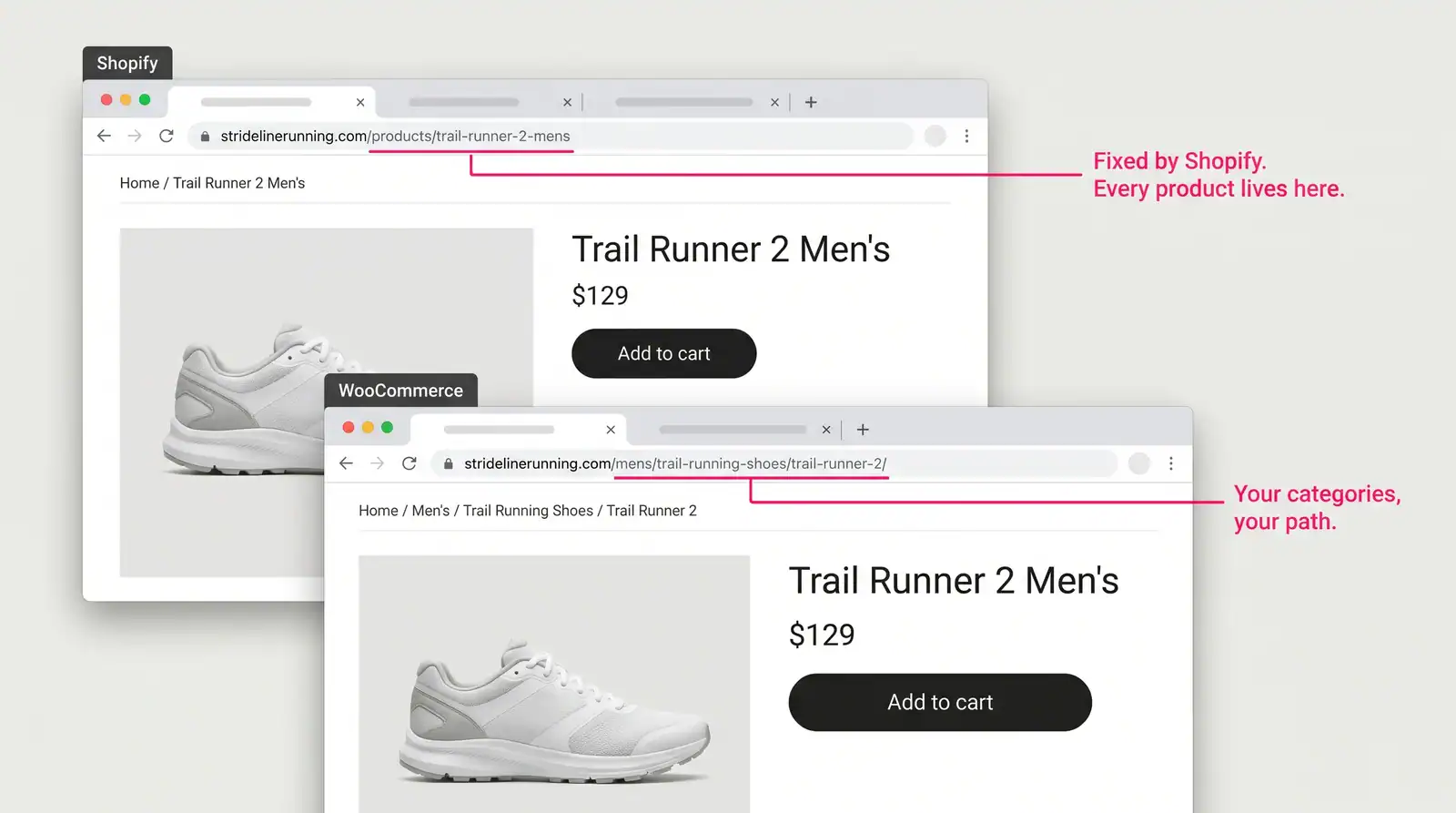
Shopify locks its URL structure. Every product lives under /products/ and every category under /collections/, and you cannot change it. For most stores this is cosmetic. For stores that win on deep category architecture, the tiered category work we use on dealer and inventory sites, where a category like box trucks for sale needs its own clean path and sub pages, WooCommerce’s full URL control is a real advantage rather than a preference. Blogging runs the same direction. WooCommerce sits inside WordPress, the strongest publishing tool there is, and Shopify’s blog is an afterthought that fights you at scale.
Shopify answers back with speed and uptime you do not have to earn. A badly hosted WooCommerce store is slow, and a Shopify store is fast without anyone trying, which matters because speed is a ranking input and an abandonment input. A well built WooCommerce store on real hosting matches it, but the words well built and real hosting are doing work in that sentence, and they are exactly what the cheap version skips. Our WooCommerce SEO guide covers the ownership side, and the checkup that applies to both platforms lives in our ecommerce SEO audit guide.
One question buyers started asking us this year deserves its aside. Clients now ask which platform performs better in AI search, since ChatGPT and Google’s AI answers are recommending stores by name. The honest answer is that the platform matters far less than the structure on it. Clean product schema, original product content, and brand mentions decide AI visibility, and both platforms can carry all three. It is the exact work of our generative engine optimization service, and it transfers whichever way you pick.
What movers really do, from our own data
We pulled the migration searches out of Ahrefs on September 27, 2026, and the direction surprised people in our own shop. Around 550 Americans a month search for moving WooCommerce to Shopify across the common phrasings, against roughly 115 a month for the reverse. Five to one, toward the rental.
An agency that leans toward ownership should sit with that number instead of hiding it, so here is my read. People do not leave WooCommerce because it ranks worse or costs more on paper. They leave because nobody was maintaining it, the store got slow or broke, and paying Shopify to make the problem go away is a rational decision. The five to one number is not a verdict on the software. It is a census of stores that never budgeted for a landlord’s responsibilities. If you have maintenance covered, you are not in that statistic, and if you know you never will, believe the statistic and rent.
The checkout claim, handled honestly
Shopify says its checkout converts up to 36 percent better than competitors, about 15 percent on average, citing a study it commissioned from one of the Big Three consulting firms. The number gets repeated everywhere as settled fact, so two things belong on the record. Shopify paid for the study, and the full methodology is not public. Nobody independent has reproduced it, and I cannot tell you how much of the gap survives a fair test against a well built WooCommerce checkout rather than an average one.
What I can tell you is that the direction of the claim matches what we see. Shopify’s checkout is genuinely excellent, Shop Pay is a real conversion asset, and a stock WooCommerce checkout loses to it until someone puts work in. Take the direction seriously and hold the exact number loosely.
Five questions that pick your platform in ten minutes
Answer these in order and stop at the first hard answer.
- Name the person who applies updates, monitors security, and fixes the store when a plugin update breaks it at 9pm. If nobody comes to mind and you will not hire one, pick Shopify and stop reading.
- Check your payment needs. A required outside gateway, financing partner, or high risk processor means Shopify taxes every sale, and WooCommerce just works.
- Count your content ambitions. A store that plans to win through category architecture and publishing belongs on WooCommerce. A store that sells through ads and social can live anywhere.
- Price your app stack. List the Shopify apps you would need and their monthly fees, times 60 months. Owners doing this math for the first time tend to sit back in their chair.
- Decide how much you care that it is yours. Some owners cannot sleep as tenants, and some never want to think about a server. Both are legitimate, and only one of them is you.
Who should pick which, and who should pick neither
Pick Shopify when nobody on your team will touch maintenance, when you sell primarily through ads and social rather than search, when Shopify Payments works for your business, or when you need to be live in weeks with no technical help. Pick WooCommerce when you have maintenance covered, when a payment provider outside Shopify Payments is non negotiable, when deep category and content SEO is your growth plan, or when ownership is a requirement rather than a preference.
Pick neither when you sell a handful of products as a side business. A 20 product store does not need a $39 a month platform or a maintained WordPress build, and the honest move is the simplest checkout you can attach to the site you already have. And be suspicious of anyone whose answer does not depend on your situation. Our ecommerce builds run $30,000 to $40,000 on WooCommerce or Shopify, so we have every incentive to tell you that you need one, which is why the paragraph above exists.
FAQs
On paper yes, in practice only if maintenance is genuinely covered. WooCommerce has no platform fee and no payment surcharges, and it carries $100 to $300 a month in real hosting plus upkeep. Shopify starts at $39 a month plus apps, and adds up to 2 percent of revenue when you use outside payment providers. High volume stores with specific payment needs usually come out ahead on WooCommerce, and small stores with no technical help usually come out ahead on Shopify.
Neither ranks better by default. WooCommerce gives full control of URL structure and sits inside WordPress for publishing, which matters for stores that grow through content and deep category architecture. Shopify gives speed and stability without effort. The store that wins is the one with original product content, clean structure, and someone doing the work, on either platform.
Yes, and it costs real money and real risk, because products move cleanly while themes, apps, and URL structures do not. A platform switch is a full migration with everything that implies for rankings, which is why the maintenance question should be answered honestly before the first build, not after the second one.
The one your answers above point at. We are a Shopify Partner and we build hand coded WooCommerce stores, we run our own store, and we have sent buyers in both directions in the same month. When an agency’s recommendation never changes, the recommendation is about their stack, not your business.