


Ad costs up, organic flat
Every quarter the ads cost more, and organic sales sit where they were. The store ends up depending on paid traffic because nothing else grows.

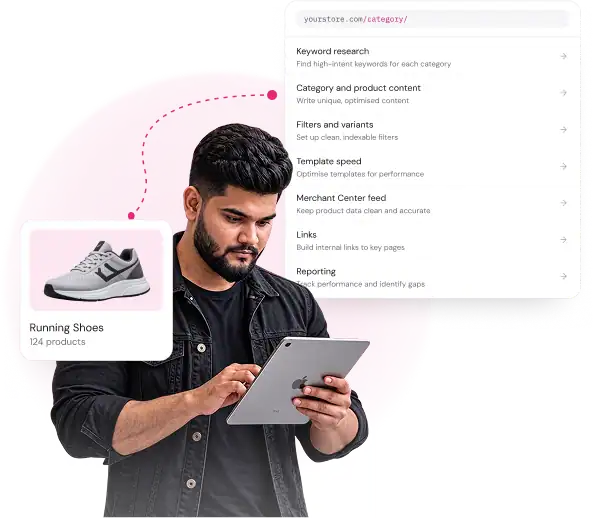
Ecommerce SEO is the ongoing work of getting a store found, in regular Google results, in Shopping, and now in AI answers. Day to day it looks like keyword research sorted by category instead of blog topic, real content on category and product pages, control over the thousands of URLs that filters create, fast templates, an accurate Merchant Center feed, links, and reports that talk about orders instead of positions.
A store is harder to rank than a normal website for one reason. It never sits still. Products come and go, one item lives in six colors and three categories, and a filter panel can quietly mint four thousand URLs before anyone notices.
Get Started Today!Almost nobody calls an agency asking for ecommerce SEO. They call because the numbers stopped working, and it traces back to one of three things: the structure of the store, the content on the pages, or the product data.
Every quarter the ads cost more, and organic sales sit where they were. The store ends up depending on paid traffic because nothing else grows.
Amazon and the big box sites rank for products you stock, while your own category pages sit below page two.
The filters generate URL after URL, Google indexes those, and the one page you want to rank is nowhere.
Products do not show in Google Shopping or AI answers, or they show with the wrong price and availability.
The blog brings visitors, they read the post, and they leave without a product page ever loading.
The store moved platforms or got a redesign, and rankings that took years to earn went with it.
Alongside the agency, we own and operate an online retail business in a category dominated by national chains. We took it to the top ten in the country in four years, competing against Home Depot and Lowe’s, using exactly the work described on this page.
in the United States in our category reached in four years, from zero
in online sales in a year on WooCommerce, our own money
completed orders from around 17,000 customers
products live on our own WooCommerce store, running on the same build this page sells
This is why we argue about filters and canonicals and feed accuracy with more conviction than most agencies. When a product page 404s on our store, it costs us money that afternoon. We learned every fix on this page by paying for the mistake first.
This is the work that ranks a store for purchase-intent searches and turns those visits into orders.
A one time teardown. We crawl the store, verify every structural, technical, and content problem we find, and rank the list by what each one costs you. Take the document and run with it, or have us make the fixes. Audit scope and pricing.
We go after searches with buying intent and sort them by category. Each important term gets exactly one page that owns it, and the category pages get real copy so they stop competing with each other.
Your best sellers get descriptions written for them instead of the manufacturer paragraph sitting on four hundred other sites. Titles get matched to how people search. Schema puts the price, stock, and star rating right in the search result.
Filters, sorting, pagination, variants, discontinued products. We set the rules for what Google is allowed to crawl so it spends its time on pages that can earn an order, and we do the speed work on the category, product, and cart templates, because a slow page in any of those three costs a sale.
We set up Merchant Center and keep the feed saying the same thing as the pages. That match is what qualifies products for free Shopping listings, AI Overviews, and ChatGPT shopping.
Each platform breaks in its own way. Shopify needs collection URL cleanup and duplicate product routing. WooCommerce needs template and plugin surgery. Both need internal links pushing authority at the categories you want to grow.
On most stores we crawl, about a third of the products sit five or more clicks from the homepage, and Google barely sees them. We rebuild the linking with category hubs, related products, and content that links to what it describes, until everything that can sell sits within reach.
The homepage usually scores fine. The product template loading forty images and six scripts does not. We fix the templates the catalog runs on and check the results against field data, not a lab test.
Content alone does not put a category page above a marketplace. We earn links from the publications and communities your buyers read, and we point them at the categories that need the authority instead of at the homepage.
We keep a full time 3D artist on staff for original product images and renders. When fifty retailers sell your SKU with the same supplied photo, yours has to look different to get picked. More on that below.
Once a month you get a report on which categories grew, what organic revenue came in, which product pages entered or dropped out of the index, and what we shipped. Rankings are listed, not celebrated. A move from position nine to six only matters if it sold something.
Everyone warns you about using the manufacturer’s product description. Hardly anyone mentions the photos, and the photos have the same problem.
When your listing and fifty others carry the identical supplied image, Google and the shopping models have nothing to pick you on except price, and the cheapest seller wins that every time. We learned this on our own store, which is why there is a 3D artist on our payroll making original product imagery.

Three of these are on every store we look at. They are invisible from the front end, which is why they survive so long.
Every combination of size, color, price, and brand gets its own URL. Google crawls the lot, your ranking signals get spread across thousands of near duplicates, and the page you wanted to rank drowns. The fix is deciding which combinations people search for, indexing those, and blocking the rest.
One product in six colors is six nearly identical pages, and a product in three categories is three URLs. Left alone, Google picks one at random or ranks none. Canonicals and consolidation make sure the version with the links and the reviews is the one that ranks.
Delete a discontinued product and every link and ranking that page earned goes with it. Leave hundreds of dead products live and Google wastes its crawl on things nobody can buy. Retired products should redirect to the closest replacement. Seasonal ones stay live with a restock note.
Traffic dropped in August and nobody could say why. We pulled the lost keywords, and every single one traced to a product page. When a unit sold, the page got deleted. No redirect, no replacement, hundreds of times a year.
The US store ranked for nothing. A previous developer had copied the overseas parent site onto the US domain and left the canonical tags pointing back at the original, so every US page was telling Google to count the other site instead.
“Google is a database. You have to feed it like a database.”
Most of what gets sold as ecommerce SEO is organization, not science. Which pages exist, which URLs Google is allowed to see, whether your product data says the same thing in three places. Most of it gets simple once somebody sits down and looks.
Google assembles AI Overviews, AI Mode shopping results, and free Shopping listings from the Shopping Graph, and the Shopping Graph is fed by Merchant Center and by the structured data on your product pages. ChatGPT shopping pulls from the same kind of sources, merchant feeds and clean product pages.
Which means your feed is SEO work now. A store with accurate titles, GTINs, availability, pricing, and review data qualifies for these placements. An incomplete feed gets left out, and it does not matter how well the page itself ranks.
Whether ChatGPT recommends your brand when someone asks who to buy from is a different job with its own page, generative engine optimization. This page covers the product level work, feeds, schema, and getting individual items cited.
Generate Engine Optimization Services
visits a month on WordPress and WooCommerce

courses restructured into a catalogue that sells

We are a Shopify Partner and we have been building WooCommerce stores since 2009. The theme changes, redirects, schema, and feed work that come out of an audit get shipped by our own team, inside your theme, usually the same month we find them.
Nothing waits in a document for a developer who has never seen your store. This is the difference between an audit that gets read and one that gets shipped.
One point of contact who knows your store, and a team that carries on while your office is closed. Ask a question at 5pm and it’s usually done by morning.
If the structural problem turns out to be the build itself, we can say so and fix it, rather than optimising around a platform decision that was wrong three years ago.

Our default. Full control of the template and your own payment processor.

Shopify Partner. Collection URLs and duplicate routing are the two things to watch.

Usually a store deciding whether to stay or move. We’ll tell you which.

B2B catalogues, customer-specific pricing, quote workflows.
Also custom builds, and dealer or parts catalogues running on inventory feeds.

We crawl the whole store, sort the keywords by category, and make a call on every URL type. Which gets indexed, which gets blocked, which gets consolidated. The feed and schema get assessed in the same pass. You get the structure plan in writing before anything changes.

The theme level changes go live. Canonicals, filter rules, redirects for retired products, speed work on the category and product templates. Category content starts on the pages with the most revenue behind them.

The best selling product pages get rewritten, the Merchant Center feed gets cleaned and resubmitted, and the internal linking gets restructured to push authority at the target categories. You get the first organic revenue report by category.

The ongoing work of ranking an online store in Google and getting its products into Shopping and AI results. It covers keyword research sorted by category, content on category and product pages, technical control over filters, variants, and out of stock products, site speed, feed management, links, and reporting tied to revenue.
Ongoing work runs $3,000 to $10,000 a month and up, depending on catalog size, platform, and competition. One time audits are fixed price and start at $2,500 for stores under 1,000 products. Full detail on the SEO pricing page.
Category rankings usually start moving two to three months after the structure gets fixed. Revenue growth you can see in the numbers takes about two quarters for most stores. Big catalogs on young domains take longer. Stores with an existing link profile move faster.
If people search for what you sell by name or type, yes, and a small catalog is an advantage, since every page can get real content. If nobody searches for what you sell, put the first dollars into paid social and come back to SEO once demand exists.
The audit is a one time project. We crawl the store, find the problems, and hand you a fix list in priority order, with the option to have us ship the fixes. Ongoing SEO is the monthly work that builds on it, content, feeds, links, and adjustments as the store changes.
Yes. We are a Shopify Partner, and we build Shopify stores as well as rank them. Shopify gets the basics right on its own and creates two specific problems, collection URLs and duplicate product routing, both of which we deal with constantly.
Yes, and it comes down to product data. AI shopping results get assembled from Merchant Center feeds and structured product pages. A complete feed, schema that matches it, and product content of your own put you in position to be the listing that gets cited instead of one of the forty identical ones.
Both, in the right order for your store. Ads bring sales this week and stop the day you stop paying. SEO takes months and then keeps producing with no per click cost. Most of our clients run ads on the high margin products while the SEO builds category traffic that pulls the cost per sale down.
For a store, yes, and the reason has shifted. Search volumes are falling as AI answers take the top of the funnel, but those AI shopping results get built from the same feeds and pages that SEO work produces. A store with a clean feed and its own product content shows up in both. A store without them shows up in neither.
It writes product descriptions and category copy well, and we use AI tools in this work every day. It cannot crawl your store, decide which of four thousand filter URLs deserve to exist, reconcile your feed against your schema, or ship a change to your theme. The writing got faster. The decisions still need someone who can see the whole store.
Ask three things. Whether they implement the fixes or just document them, because an audit nobody ships is worth nothing. Whether they will give you a price before a proposal call. And whether they have ever run a store themselves, because filters, variants, and out of stock handling are things you learn by running a store, not by reading about one.
How many URLs your filters are generating, what your feed is missing, which product pages died quietly. On a call, on your screen. If the answer is that your store doesn’t need us yet, we’ll say that instead.


