
A rebuild that went backwards
Traffic dropped the week the new site launched, because URLs changed and content that was working got thrown away.

We see the same six problems over and over, and almost none of them are about how the site looks.
Traffic dropped the week the new site launched, because URLs changed and content that was working got thrown away.
The last site we took over ran 37 plugins. We rebuilt it on 5, and it loaded in a fraction of the time.
Your site looks like every competitor because it started from the same theme they did.
Visitors click through three pages and never land anywhere they can call you or pay you, because the menu was built around your org chart instead of their questions.
No page structure, no internal linking, and no way for Google to tell what any page is about.
Every small change is an email to a developer and a three day wait.
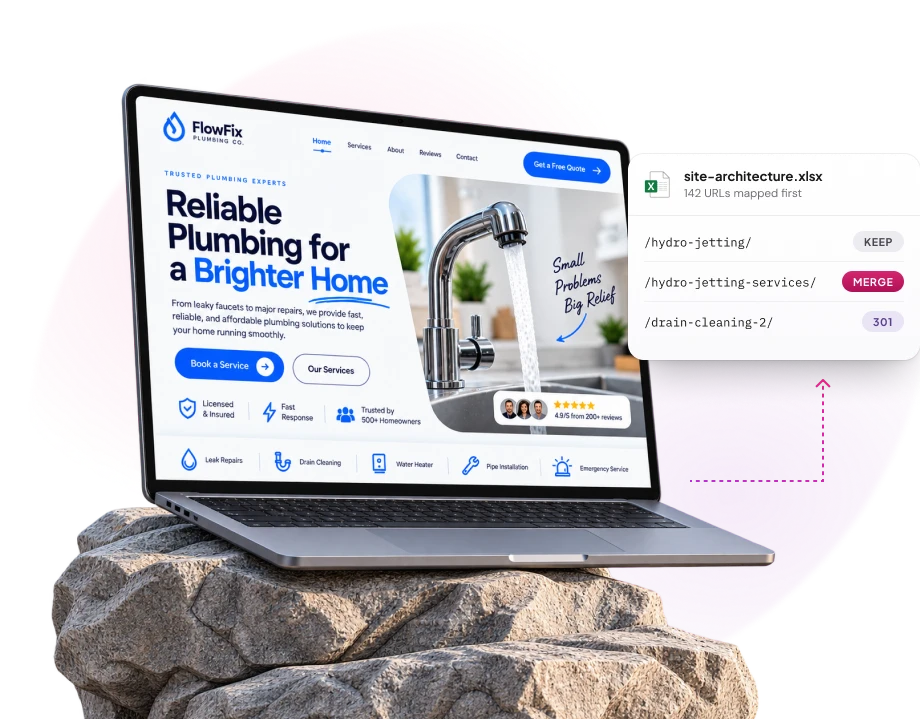

Before a designer opens a file, we crawl your website and map every URL on it. Each page gets a status code, a page type, a keyword theme, and an intent label, commercial, informational, or local. Then we mark what happens to it. Keep, merge, or redirect.
The intent decides what each page has to look like. A commercial page needs pricing, proof, and a call to action, an informational page needs depth and internal links. The sheet also shows which pages carry your traffic today and which ones compete with each other. You get a copy, and you decide what stays.
This step is why our clients do not lose rankings in a rebuild. When we know which pages bring in your traffic before design starts, nothing that ranks gets deleted, renamed, or moved by accident.
See what we'd find on your siteThe fastest way to lose traffic when replacing a website is changing the URL structure. A page that ranked for ten years at one address becomes a 404 at a new one, and the rankings go with it. Every new build we do starts from the URL map, so what ranks today still ranks after launch.
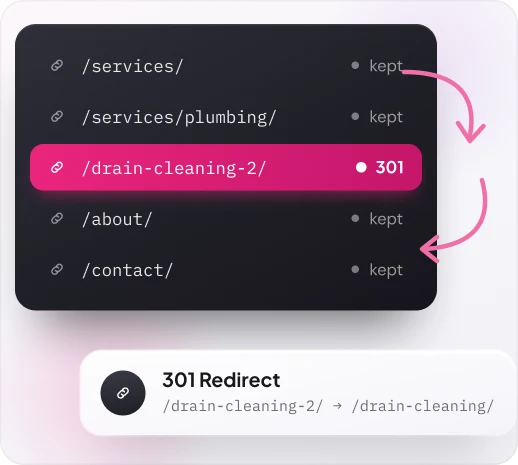
We keep as many URLs intact as we can and avoid unnecessary 301s, since every redirect is a small tax on a page’s authority. Where one is genuinely needed, it is mapped before design starts, not discovered after launch.
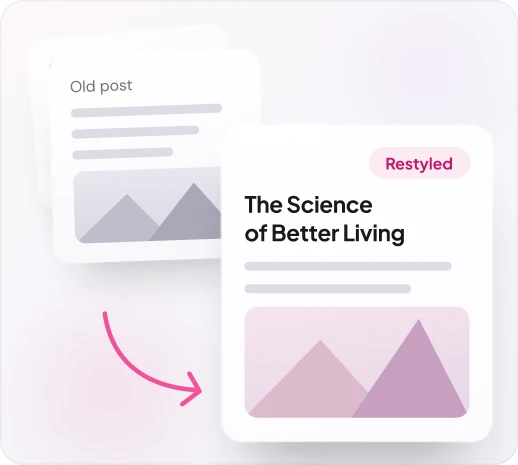
When old posts carry markup from a previous theme, we strip it programmatically and restyle them, so a blog with a thousand posts does not have to be fixed one post at a time.
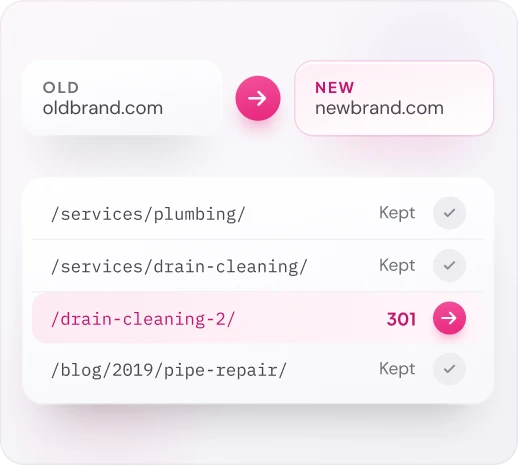
A rebrand or a new domain forces it. We map the redirects first, tell you what the expected dip looks like, and time the launch so it costs as little as possible.
Most small businesses get this backwards. They optimise the homepage for one city, then can’t rank anywhere else without rebuilding the site.
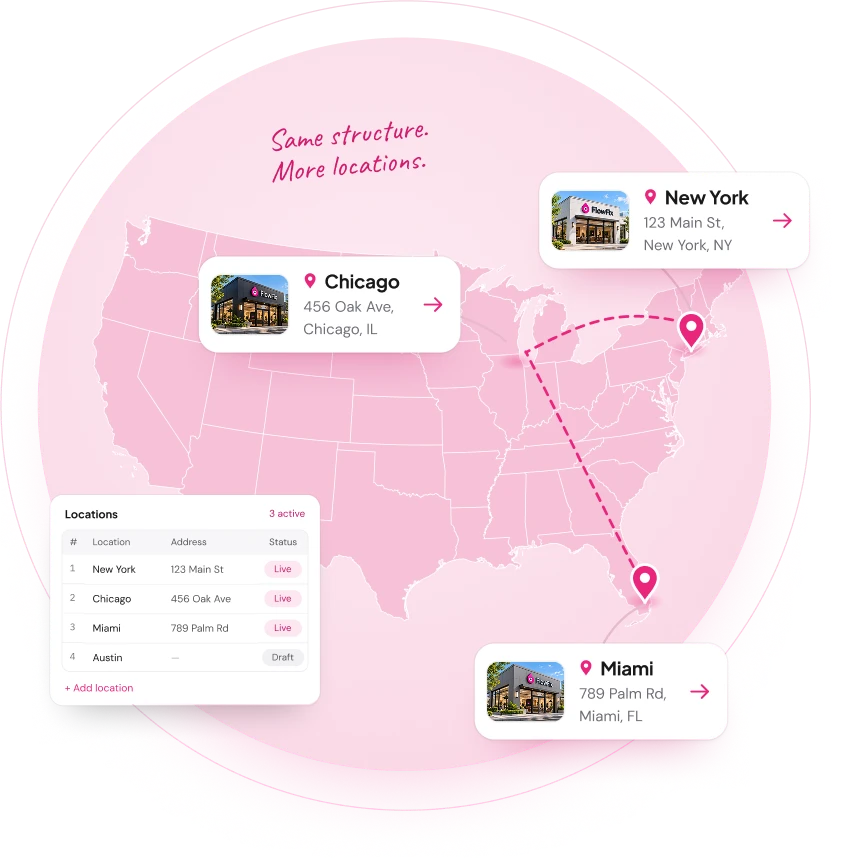
We build the structure you’ll need in three years, not the one you need today. Service pages live at the root and speak to your whole market. Each location gets a hub with its own service pages underneath it. Add a second office and it slots in, no restructure, no redirects, no lost rankings.
We build it this way even if you only have one location today. It costs nothing extra, and it saves you a rebuild later.
We build on four platforms and we’ll tell you which one fits before you pay for anything. The wrong platform costs more to escape than it saved to choose.

Our default. Hand-coded on the WordPress core. No page builder, no commercial theme, and rarely more than five plugins.

For stores that want to choose their own payment processor instead of handing a platform a percentage of every sale.

When you want the operations handled for you. We’re a Shopify Partner, and we build custom themes rather than reskinning a stock one.

For teams already running sales and marketing in HubSpot who want the website in the same system as the pipeline.
We learn how you actually make money. Which services carry the margin, where leads come from today, who you lose deals to. Not a questionnaire. A conversation, usually an hour.

We crawl your site, map every URL, and give each page one job and one target keyword. You sign off on the sheet. Nothing gets designed until this is settled.
Greyscale layouts. No color, no images, no logo. If a page can’t tell its story as boxes and text, no amount of design will save it.
Full color, real content, your photography. Homepage first, then templates. This is where projects slow down, so revision rounds are in the schedule rather than pretended away.
Built in HTML first, then WordPress. Hand-coded on the core. No page builder, no commercial theme. W3C standards, Core Web Vitals in the 90s at launch.
Every URL checked against the architecture sheet first. We launch on a Monday, never a Friday. Recorded training, then thirty days of support, on the schedule as its own line.

Every section of your site is a block you can copy and paste onto any other page. Build a new service page out of the parts that already exist, without a developer and without writing a line of code.
Change a block that appears site wide, a call to action, a promo bar, a contact strip, and it updates on every page at once.
Call us for the complex work. You should not have to pay anyone to change a phone number.
Talk to usYour site runs on our servers, but the website is yours. You get access to your files and full admin access from day one, and if you decide to leave, we hand everything over and help you move it. We want you to work with us, not be stuck with us.

Registered in your name, in your account.

Your own cPanel, in your name. Move it whenever you want.

Administrator on your own CMS from day one.

No plugin or system only we can edit.

Hosting and maintenance are optional, month to month.
Core Web Vitals are a ranking factor and a conversion factor, and they are far cheaper to build in than to retrofit. Hand-coded templates, WebP images, minimal plugins and proper caching are how we get there, and we measure it before launch, not six months after.
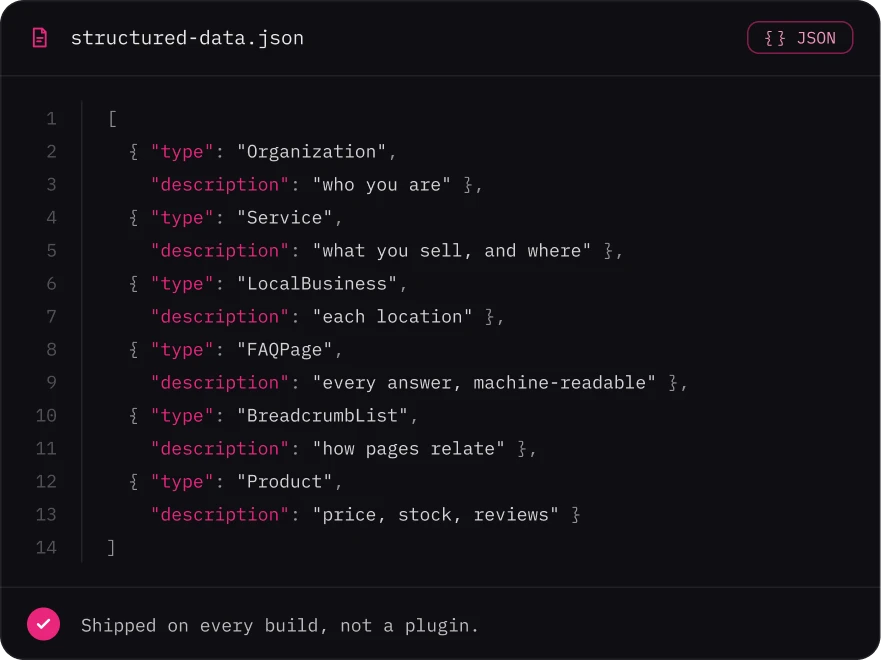
AI Overviews, ChatGPT and Perplexity don’t rank pages, they quote them. To be quoted, a page has to state facts plainly in text a machine can read, and label what those facts describe. Both are build decisions, and both are made before a word of copy is written.
“Hydro jetting in Orlando typically costs…”
“Who does emergency plumbing in Winter Garden?”
“Best drain cleaning near me”
Key facts sit in real paragraphs, not inside images or scripts. A sentence locked in a graphic can’t be quoted by anything.
Content is in the HTML on first load. Nothing important waits for JavaScript that a crawler may never run.
A clean heading hierarchy, with each section opening on a complete statement that still makes sense pulled out of context.
One point of contact manages your project from the first call to launch, and it stays the same person the whole way through. Behind them, our team works around the clock, so a request sent at 5pm is usually done by the next morning.
Behind them, the work follows the sun. When your business day ends, part of our team is just starting theirs, so a request you send at 5pm is usually finished before you open your laptop the next morning. Nothing sits in a queue overnight or over a weekend.
Same portfolio you have now. One number attached to each, so a visitor can tell the difference between a nice-looking site and a site that worked.
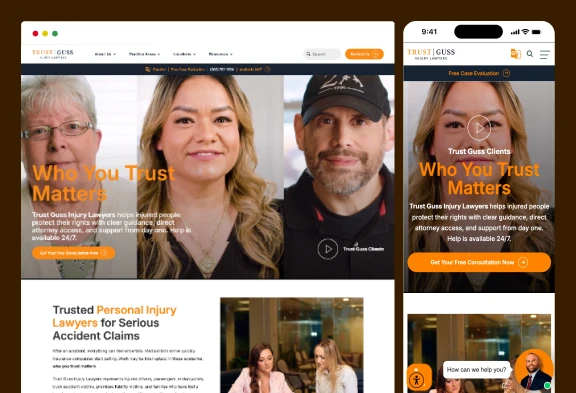
Moved a national injury firm off a proprietary platform onto WordPress, with CRM integration and lead automation.
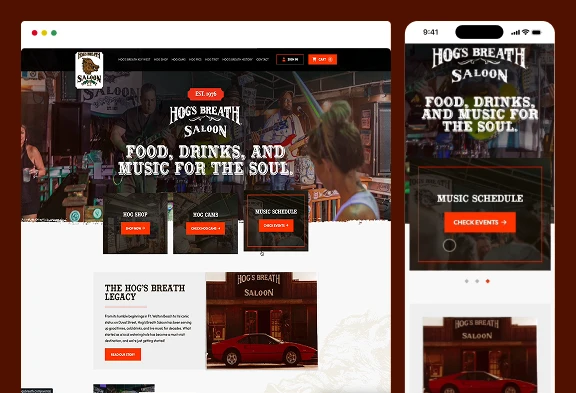
WordPress and WooCommerce handling live music scheduling, inventory integration and high-traffic ecommerce.
A 300-course catalog rebuilt into an SEO-structured ecommerce platform with LMS checkout.

We’ve designed and developed high-performance WordPress websites, ecommerce stores, and SEO-driven platforms for companies across every major industry. This experience gives us the insight to know what works in your market and how to turn visitors into loyal customers.

A custom website is hundreds of hours of work, architecture, keyword mapping, wireframes, design, hand-written code, content, and testing, spread across a team of specialists rather than one person with a theme. That’s what the range reflects.
Most business websites run $8,500 to $25,000. Multi-location, franchise, and ecommerce builds start at $20,000. A focused fix on an existing site—structure, speed, and internal linking without a redesign—starts around $5,000. We give you a range on the first call, before any proposal.
By deliverable: 30% up front, 40% when the site is built and viewable in WordPress, 30% at launch. No retainer required afterwards.
Three to four months for a standard build, from kickoff to launch. Simple sites can be done in two. The variable is almost never development. It’s how fast content, photography and approvals come back.
Not if the URLs are mapped first. We crawl every existing page, map each one to its replacement, and redirect anything that merges. Rankings drop in a redesign when content that was working gets discarded and addresses change, both avoidable, and both planned for before design starts.
Yes. Every section is a block you can copy onto another page, and sitewide blocks update everywhere at once. You get a recorded training session at handover. Come to us for complex work, not for a phone number change.
You do: the design, the code, the content and the domain. Your site runs on our servers, and you get FTP access to your files and administrator access to your CMS from day one. Nothing is built in a proprietary system only we can edit, so if you ever want to move, we hand over a full export and help you do it.
Constantly. We’re the build partner for a number of SEO and marketing agencies, so we’re used to taking architecture and keyword targets from someone else and building to them. We don’t sell SEO retainers in competition with your agency.
WordPress, hand coded on the core, with no page builder and no purchased theme. WooCommerce or Shopify for ecommerce, and HubSpot CMS for teams already running their pipeline there. We will tell you which one fits before you pay for anything.
Yes, as long as the budget fits the ranges above. If a full build is not the right spend right now, we will say so and point you at the fix that is. Plenty of first calls end with us recommending a facelift or a handful of fixes instead of a new site.
No deck, no discovery questionnaire. We’ll look at your site, find the three things holding it back, and show you on a call. If a rebuild isn’t what you need, we’ll tell you that too.